Master Purchase Price Allocation Accounting
PPA Meaning in Valuation: Understanding Purchase Price Allocation and Its Role in Financial Analysis
Introduction to Master Purchase Price Allocation Accounting
PPA is another term that can be often met in the context of valuation and financial reporting when referring to mergers and acquisitions. The meaning of PPA in valuation is crucial to the finance professionals, valuers, auditors, and corporate decision-makers because it has a direct impact on the representation of acquisitions in financial statements and the evaluation of post-acquisition performance. Valuation and PPA are interconnected since the methods of valuation are the basis of assigning purchase consideration to identifiable assets and liabilities.
The paper describes the PPA full form in valuation, the idea of valuation of PPA and why PPA is an essential bridge between deal pricing, accounting standards, and long-term values measurement.
PPA Full Form in Valuation and Its Core Concept
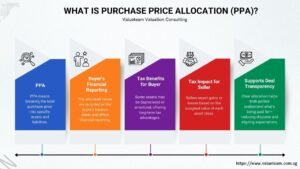
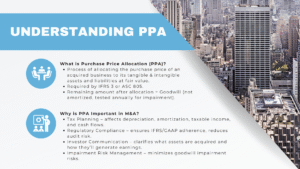
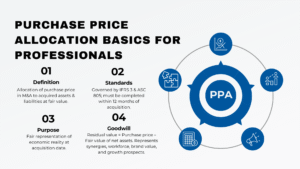
Purchase Price Allocation is the PPA full form in valuation. Purchase Price Allocation refers to the procedure of allocating the total amount paid in a business union to identifiable assets obtained and liabilities taken over at fair values on the date of acquisition. Any remaining balance on this allocation is classified as goodwill.
PPA is not an accounting process as far as valuation is concerned. It involves strict use of valuation principles in arriving at a fair value of tangible assets, identifiable intangible assets and assumed liabilities. This allocation would impact future periods of depreciation testing, amortization, impairment testing and reported profitability.
PPA Meaning in Valuation Practice
The meaning of PPA in the valuation extends past the accounting requirements of either the IFRS 3 or ASC 805. Practically, PPA is a systematic process of valuing that decomposes the price of transactions into asset values that are economically significant. This is done to ensure that the price of an acquisition is broken down into elements which indicates the driving forces of value.
Valuers undertaking PPA have to appraise customer relationship, brands, technology, contracts, licenses, and other intangible assets as to income, market, or cost approach. The resulting values do not only impact the financial reporting but also the internal performance measurements as well as the strategic decision-making.
Valuation of PPA and Fair Value Measurement
PPA is measured based on fair value measurement standards. Fair value is the amount that one receives in order to sell an asset or pay to transfer a liability in a market transaction to order participants. This in a PPA context will necessitate market based assumptions as opposed to entity based ones.
The multi-period excess earnings method, relief-from-royalty method, the multi-period excess earnings method, and the discounted cash flow analysis are the commonly utilized income-based techniques in valuation of PPA especially on intangible assets. The techniques depend on forecast, discount rates and useful life projections and hence professional judgment and valuation skills are very essential.
Valuation and PPA in Financial Reporting and Analysis
The centrality of valuation and PPA in post-acquisition financial reporting is a central concept of the relationship. After the purchase price allocation has been made the values of the recognized assets determine the future amortization and depreciation costs, which in turn directly impact the earnings and other financial ratios.
Moreover, the level of goodwill realized by way of PPA is liable to a test of impairment each year. Hyped or de-hyped PPA can thus contribute to misrepresenting financial outcomes, the economic performance and heighten the potential of future write-downs.
To investors and analysts, it is important to know how valuation assumptions are used in PPA during company comparisons, and in the success of acquisitions and the returns on invested capital.
Strategic Importance of PPA in Valuation Work
In addition to being compliance-related, PPA is strategic in terms of valuation and corporate finance. A properly implemented PPA gives one an idea of what an acquirer in reality acquired; it could be growth opportunities, intellectual property, customer relations, or synergies. It also assists in alignment of deal valuation and integration planning as well as creating long-term values.
When it comes to cross-border acquisitions or regulated industries, valuation and PPA are even more important, as there is a difference in accounting frameworks, taxation, and regulatory oversight.
Conclusion
Overall, the PPA meaning in valuation has to do with applying valuation principles in the allocation of the purchase price in an acquisition to identifiable assets and liabilities at fair value. Purchase Price Allocation abbreviated as PPA in valuation is a crucial connection between pricing deals, accounting standards, and transparency of finances.
PPA valuation represents a technical art that needs valuation skills, judgment, and understanding of assumptions of the market participants. Finally, good understanding of valuation and PPA helps organizations to generate sound financial reporting, increase stakeholder confidence and make superior informed strategic decisions in the aftermath of business combinations.
Frequently Asked Questions
Q1. What is Purchase Price Allocation (PPA) Accounting?
Purchase Price Allocation (PPA) Accounting is the process of allocating the purchase price paid in a business acquisition among the acquired company’s identifiable assets, liabilities, and goodwill. The objective is to ensure that acquired assets and liabilities are recorded at their fair values on the acquisition date, in accordance with applicable accounting standards.
Q2. Why is mastering Purchase Price Allocation Accounting important?
Understanding PPA Accounting is essential because it directly affects financial reporting, future earnings, depreciation, amortization, impairment testing, and compliance with accounting standards. Proper allocation provides transparency into the economic value of acquired assets and helps stakeholders evaluate the success of acquisition transactions.
Q3. What are the main components of Purchase Price Allocation?
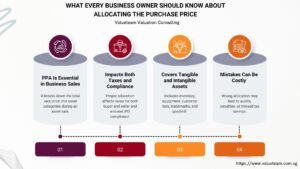
The main components include tangible assets, identifiable intangible assets, liabilities assumed, deferred tax impacts, and goodwill. Identifiable intangible assets may include customer relationships, trademarks, technology, licenses, contracts, and intellectual property, depending on the nature of the acquired business.
Q4. How is goodwill treated in Purchase Price Allocation Accounting?
Goodwill represents the excess of the purchase price over the fair value of the identifiable net assets acquired. It reflects benefits such as expected synergies, workforce expertise, reputation, market position, and future growth opportunities that cannot be separately recognized as identifiable assets. Goodwill is generally subject to periodic impairment testing rather than amortization.
Q5. What challenges do professionals face when performing Purchase Price Allocation?
Common challenges include identifying all relevant intangible assets, selecting appropriate valuation methodologies, estimating fair values, assessing useful lives, calculating deferred tax impacts, and ensuring compliance with accounting standards. Because acquisitions often involve significant judgment and complex assumptions, PPA exercises frequently require specialized accounting and valuation expertise.