Singapore Purchase Price Allocation (PPA) Requirements Under IFRS 3
1. Introduction to Singapore Purchase Price Allocation Requirements
Definition and Significance of PPA in Merger and acquisition
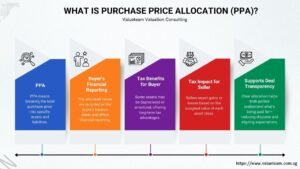
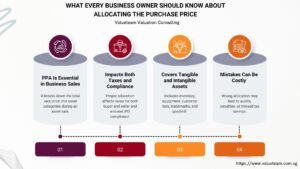
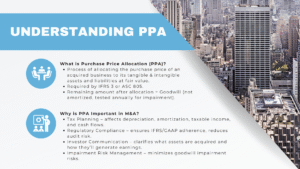
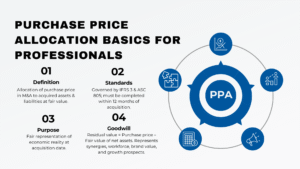
Purchase Price Allocation (PPA) is a process that is involved in mergers and acquisitions (M&A) to allocate the total amount paid during an acquisition between identifiable assets acquired and liabilities to be allocated at their fair value. It is central to post-deal financial reporting, and not just a formality of compliance, but it forms the core of how the acquired business will be reported to the balance sheet of the acquirer, the impact of depreciation and amortisation on future earnings, and what the investors and the regulators will see as a clear picture of what was actually acquired and on what price.
In Singapore where cross-border M&A is now a common practice especially in the financial services, technology, and real estate industries, a stringent PPA exercise would provide the financial statements with financial substance to the economic sense of the transaction. Goodwill may be misstated, intangible assets may be understated, or adverse audit results may have reputational and financial consequences as a result of errors or oversimplifications in PPA.
Requirements of the IFRS 3 Singapore to allocate purchase consideration to fair value assets/liabilities
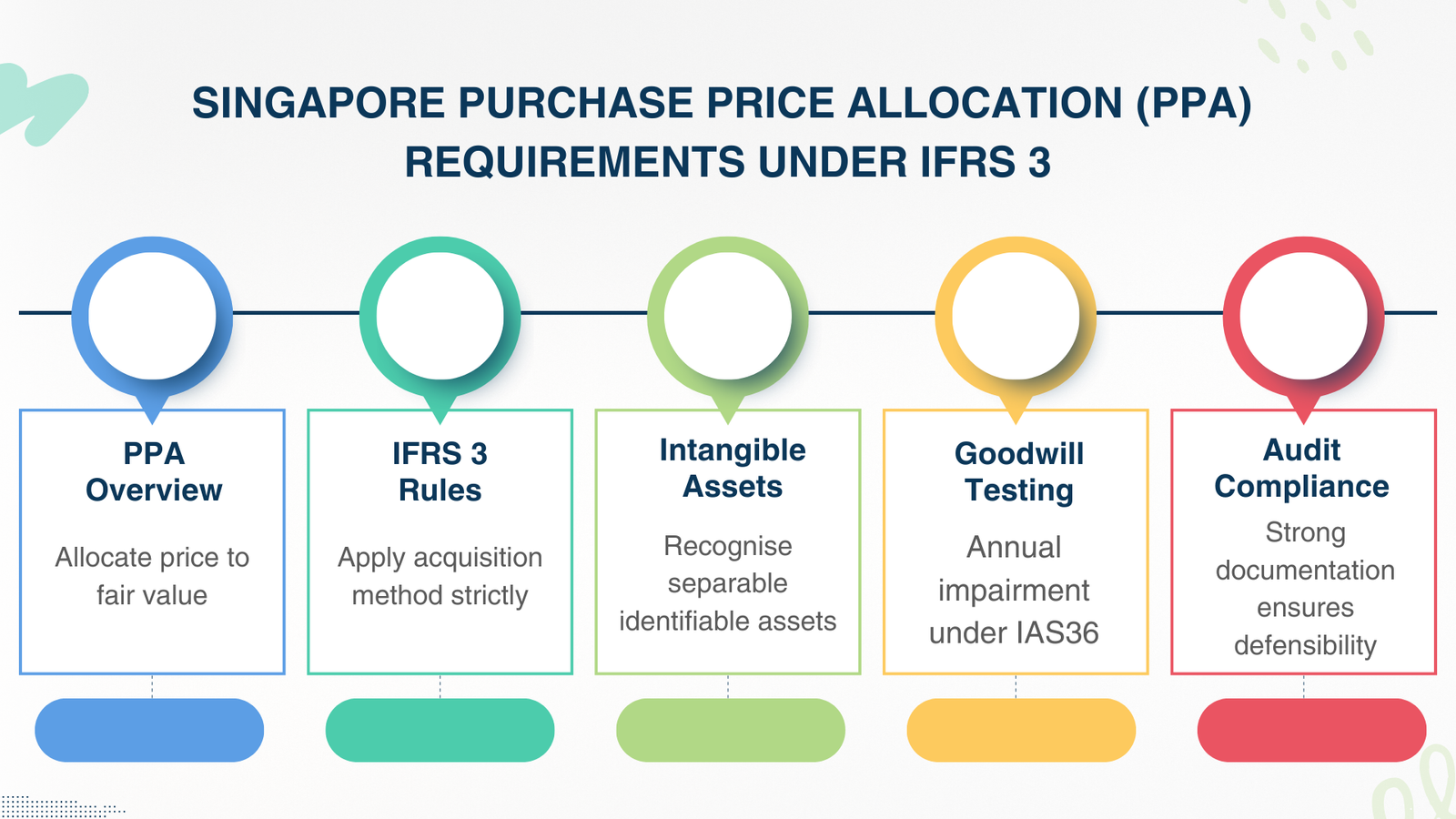
The Singapore Financial Reporting Standards (International) system puts in place IFRS 3 Singapore Business Combinations, which in Singapore is known as SFRS(I) 3, requires the acquiring entity to recognise and measure all identifiable assets acquired, liabilities assumed, and any non-controlling interest at their acquisition -date fair values. This allocation must be done as per the standard before the end of the measurement period that must not take more than 12 months to the acquisition date.
The aim of the IFRS 3 Singapore is to enhance relevance, reliability and comparability of financial information regarding business combinations. The standard is very important because it mandates fair value measurement instead of historical cost requirement, resulting in the stakeholders being provided with meaningful information about the economic resources that have transited through hands.
2. What do we mean by Purchase Price Allocation?
Core Concept Under IFRS 3 Singapore
In its very simplest form Purchase Price Allocation Singapore is a systematic effort to break down the total consideration transferred in a business combination into its parts. Under IFRS 3 Singapore, consideration passed is cash paid, equity instruments issued, contingent consideration arrangements and any interests held in the acquiree previously. After deciding on the amount of consideration, one should take care of matching it with fair values of all identifiable net assets.
Examples of identifiable assets are both tangible (such as property, plant and equipment and inventory) and intangible assets (such as customer relationships, brand names, technology platforms and licences). Strong liabilities assumed consist of current financial liabilities, deferred revenues, and contingent liabilities, and other contract liabilities. The net amount or the difference between total consideration and fair value of net assets is the goodwill, which captures synergies, assembled workforce and other indefinable value drivers.
Why PPA is Important to the Accuracy of Financial Reporting
Properly carried out Purchase Price Allocation has a direct influence on the income statement and balance sheet of an acquirer in several years after acquisition. Amortisation of intangible assets recognised should be across their useful lives and in the process the future earnings are lowered systematically. Although goodwill is not amortised under the standards set by SFRS(I) / IFRS, it has to be impaired every year under the standards set by the IAS 36. When PPA is done improperly such as understating intangible assets and overstating the goodwill then the financial statements will not reflect the true and fair picture and the impairment charge in the future will be deferred or manipulated.
3. Major Regulatory Requirements in Singapore
IFRS 3 Singapore Compliance (SFRS(I) Equivalent
Companies and large incorporated entities that are listed in Singapore are obligated to prepare financial statements using SFRS(I), which is nearly identical, as is, to IFRS as published by the International Accounting Standards Board (IASB). So, full application of IFRS 3 Singapore requirements is applicable. Singapore Private entities can also adhere to Singapore Financial Reporting Standards (SFRS), which are largely similar to SFRS(I), but with minor simplifications of private companies.
Through both structures, the acquirer has to utilise the acquisition method that entails: (a) the establishment of the acquirer, (b) the date of the acquisition, (c) identification and measurement of the identifiable assets and liabilities at fair value and (d) goodwill or a gain of bargain purchase.
Failure to comply with IFRS 3 Singapore may lead to qualified audit opinions, restatements of accounting statements, regulatory investigation by the Accounting and Corporate Regulatory Authority (ACRA) of Singapore and loss of reputation.
Compulsory Period: The 12 Month Measurement
The IFRS 3 Singapore requires that measurement period be one of the most important aspects of the standards in which, an acquirer may retrospectively adjust the provisional amounts recognised at the acquisition date were new information is noted to have influenced the measurement of the amounts. The measure period starting on the date of acquisition and terminates at maximum of one year after the date.
The acquirer can also reconsider provisional fair values of assets and liabilities during this time as more information is known. Any modification however should be retroactive that is, should be considered as one which was realised at the date of acquisition. Once the measuring period is over, only the normal error correction provisions of IAS 8 may be used to correct the measurement by IFRS 3.
4. Step-by-Step PPA Process
Step 1: Determine Commonwealth of consideration transferred
The initial stage in a Purchase Price Allocation process is to establish the amount of acquisition consideration. Under the IFRS 3 Singapore, consideration encompasses all cash payments made at the date of closing, fair value of any equity instruments issued (e.g. shares in the acquirer), contingent consideration (e.g. earn-out arrangements) and deferred payments, and fair value of equity interests held in the acquiree previously (in case the acquisition is made in stages step acquisition).
Transaction costs, such as advisory fee, legal fee and due diligence cost, are clearly not to be considered in IFRS 3 and therefore have to be expensed as they are incurred. It is a marked difference of the older standards and may have a tremendous effect on the income statement of the acquirer during the acquisition year.
Step 2: Recognize and Appraise Tangible and Intangible Assets
After establishing consideration, all identifiable assets and liabilities of the acquiree should be listed and the fair valuation made. Market approach or cost approach normally applies in determining the value of tangible assets. However, intangible assets need specialised valuation techniques.
The standard of IFRS 3 Singapore presupposes the recognition of the intangible assets independently of goodwill, and in case they satisfy both the contractual-legal requirement (originating in the contractual or other legal rights) and the separability requirement (they can be separated and sold, transferred or licensed). This tends to bring into the limelight intangibles which were not previously recognised by the acquiree itself (internally generated brands or developed technology).
Step 3: Fair Values of purchase price allocated
Upon identifying all the assets and liabilities, the acquirer will divide the amount of total consideration between each of the components at their acquisition date fair value. This is an exercise in which all of the fair-valued assets, less fair-valued liabilities are registered against the consideration paid in total. The procedure has to be systematic and recorded, in which each valuation has to be backed by relevant evidence and procedures.
Step 4 FY Goodwill or Bargain Purchase Gain
Goodwill is the goodwill residue that will commence when consideration is greater than the net fair value of identifiable assets and liabilities. On the other hand, where the net fair value of identifiable assets and liabilities are greater than the consideration paid purchase a bargain purchase gain, which in the case of IFRS 3 Singapore is recorded in the profit or loss. Nonetheless, the acquirer should re-consider all identifiable assets and liabilities before they realise that a bargain purchase has been recognised.
5. Recognisable Intangibles under IFRS 3 Singapore
ISFRS 3 does mandate the acquirer to recognize all intangible assets which will satisfy either the contractual-legal approach or the separability criterion. Practically, the most frequent categories of intangibles that are found in transactions that are based in Singapore are the following:
Brand Equity
Intangible assets are recognised as brand names, trade names and other related marks that are legally safeguarded or can be separated off the business. Brand equity may constitute a large share of the total intangible value in Singapore where the consumer brands can have huge market value. The relief-from-royalty method of valuation is usually used.
Customer Relationships
Most frequently identified intangibles in a PPA are existing customer relationships both contractual and non-contractual. These are the economic returns on the repeat business which are usually estimated as the Multi-Period Excess earnings Method (MPEEM). which isolates the amount of cash flows that can be attributed to the relationship with the customer.
Technology and Platforms
As is common in technology companies and fintech organizations that are common in Singapore, the most relevant intangible asset is often the technology that is developed (software, proprietary platforms, algorithms). The intangibles that belong to technology could be appraised by the relief-from-royalty method or cost-to-recreate approach.
Contractual Rights
Favourable contracts, licence, franchise agreements, and non-compete agreements whose value is greater than that recorded in the rest of the assets are identified under IFRS 3 provided that they satisfy the contractual-legal requirement. Their valuation is determined by the kind of the contract and outstanding period of contract.
6. Techniques of Valuation in PPA
Relief-from-Royalty Method
It is an income-based method that uses the estimated value of an intangible asset based on the amounts of royalty payments that would otherwise be paid to license the asset to a third party. It is popular with brand equity and technology assets, apportioning the value of capitalized by observable market royalty rates. The resultant intangible value represents the savings of the company in owning the asset as opposed to licensing the asset.
Multi-Period Excess Earnings Method (MPEEM)
MPEEM is the most suitable method in valuing the customer relationship, among other main intangible assets. It approximates present values of all cash flow that can be ascribed to a given intangible asset by subtracting fair returns on all other contributory assets (tangible and intangible). In this approach, there is need to model carefully the rates of customer attrition, the trend of revenue, and the right discount rates.
With-and-Without Method
This method determines the worth of an intangible by the comparison of two scenarios between the worth of the entity at the presence of intangible and the absence of the intangible. The distinction between the two scenarios will show the fair value of the intangible. It is usually used to deal with non-compete agreements as well as some contractual deals.
Cost Approach
The cost method will determine the value of the intangible in terms of the cost of recreating it or replacing it (replacement cost new), or the amount of money that was incurred in developing the intangible (historical cost). The common use of this method is with proprietary software and assembled workforce. Although it is simpler to use, it can undervalue intangible values on established or high productivity assets.
7. Goodwill Recognition and impairment
Goodwill IFRS 3 Definition
Under the IFRS 3 Singapore, the goodwill is the asset that reflects the future economic advantages of enjoying other assets that are acquired during a business combination that are not recognized separately and identified. Economically, goodwill is the premium that an acquirer pays within synergies, workforce capability and market positioning among other non-separable sources of value.
The excess of (a) the sum of consideration transferred, any non-controlling interest in the acquiree and any equity interest previously held over (b) the net acquisition-date fair value of identifiable assets and liabilities is measured as goodwill. The more the price of purchase is in relation to net identifiable assets, the more goodwill recognised.
Annual Impairment Testing IAS 36
Goodwill unlike other intangible assets is not amortised under the IFRS. Rather, it should undergo testing of impairment at least once a year or more often in case of indicators of impairment as provided by IAS 36 Impairment of Assets. The allocation of goodwill is done to the cash-generating units (CGUs) or groups of CGUs that are likely to enjoy the synergies of the combination.
Impairment testing is used to compare the carrying amount of the CGU (what it could fetch in a sale after deduction of impairment losses) with its recoverable amount of fair value less costs to sell and value to use. When the carrying amount is more than the recoverable amount then an impairment loss is realised. Auditors place significant attention on the impairment disclosures of listed companies in the regulatory reviews that are done by the Singapore Exchange (SGX) in Singapore.
8. Ordinary PPA Nuisances in Singapore
Intangible Overlap
One of the inescapable problems in PPA is that there is a risk of counting twice within intangible assets. As an example, a customer relationship and a trade name can be used to generate the same stream of revenue. To prevent overstating total Purchase Price Allocation Singapore and have contributory asset charges correctly charged in MPEEM analyses, practitioners should closely delineate the cash flows that should be charged to each intangible.
Information Difficiency on Intangibles
The appraisal of intangibles must have sound financial projections, market royalty, and data on customer attrition. In Singapore, especially when it comes to acquiring or making deals in the niche industries of a private company, such data may be hard to get. The practitioners should be guided by industry benchmarks, estimates by the management and similar transaction information all of which should be duly documented and stress-tested.
Under the IFRS 16, Lease Liabilities
PPA exercises have been complicated by the adoption of the IFRS 16 Leases. During business combination, the acquirer should quantify lease liabilities at the present value of further payment of lease payments by using incremental borrowing rate of the acquiree at the time of the acquisition. This can also have a major implication on the net asset value of asset-intensive companies, including retailers or logistics companies in the Singapore high-rental environment.
9. Documentation, Audit Defense
Significance of Solid Valuation Documentation
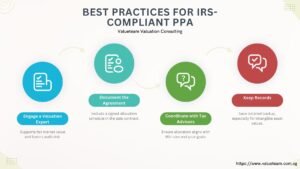
The only thing as defensible as a PPA exercise is its documentation. All assumptions, data sources, model and valuation conclusion should be well recorded in a written form of valuation report that can withstand the questioning of external auditors, tax authorities and regulators. Valuation methodology used should be described, the main assumptions made, including discount rates and growth rates, sensitivity analysis and a reconciliation of the total consideration with the allocation should be documented.
In Singapore, the preparation of valuation reports to assist Purchase Price Allocation Singapore Requirements is commonly done by qualified independent valuers e.g. Chartered Valuers and Appraisers (CVA) or Chartered Financial Analysts (CFA) to increase credibility and independence.
Audit and Tax Scrutiny Reflections
The auditors must analyze whether a PPA of a client has been carried out in line with the IFRS 3 Singapore. This involves considering the reasonableness of the identified intangibles, the suitability of valuation techniques and the completeness of disclosures in the financial statements notes. The Big Four and mid-tier accounting firms in Singapore regularly participate in the challenge of PPA conclusions by having their own valuation specialists involved.
Taxwise, PPA might be subject to review by the Inland Revenue Authority of Singapore (IRAS) relating to capital allowances, transfer pricing structure, or deductibility of acquisition related expenses. Disconnectivity between the accounting PPA and tax positions may lead to investigations and changes.
10. Conclusion
Value of Accurate PPA Reporting Value
A proper and rigorous Purchase Price Allocation Singapore exercise is much more than a technical duty of accounting it is a strategic resource in its own right. To the acquirers, a well-documented PPA gives them a clear picture of what has been acquired, at what price, and how future earnings of the acquired will be influenced. It allows making more informed decisions of integration and helps in impairment monitoring and also shows investors and regulators that the acquisition was carried out with due diligence.
Under the IFRS 3, the Singapore firms are expected to utilise the acquisition method, where all purchase consideration is to be allocated to identifiable assets and liabilities at fair value and any remaining amount is to be recognised as goodwill. The financial modelling skills, industry experience and valuation judgment necessary to meet these Purchase Price Allocation Singapore Requirements are supported by comprehensive documentation.
Due to the dynamic nature of the Singapore M&A landscape, where deals are becoming more complex and regulator are placing an increasingly greater emphasis on disclosure quality, firms that invest in the quality of PPA exercises will be better placed to report transparently, to be able to withstand audit scrutiny, and to be able to realize the full reporting value of their acquisitions.