Purchase Price Allocation (PPA) Valuation in Malaysia under IFRS
A Practical Guide for Finance Professionals
Introduction to Purchase Price Allocation (PPA) Valuation in Malaysia under IFRS
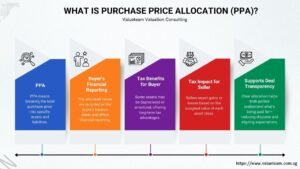
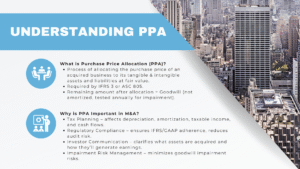
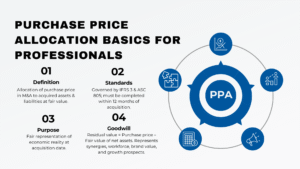
In acquisition of a company, the acquisition does not end at the signing point. Under IFRS 3 Business Combinations, the acquiring entity shall determine, identify and quantify at fair value all identifiable assets acquired and liabilities incurred as at the date of acquisition. This practice is referred to as Purchase Price Allocation (PPA) and is placed at the crossroad of financial reporting, tax planning and business strategy. To Malaysian finance professionals, the concept of PPA is no longer merely a technical knowledge base, but a growing core competency as the realm of M&A activity expands in both sectors, plantation conglomerates and the fintech platform.
Malaysian market has got its own taste of complexity. Companies in this region have a high probability of having an intangible value that may be hard to list on the balance sheet such as a base of loyal customers formed over the decades, manufacturing knowledge, or locally developed brand loyalty, and licences or concessions in the government. Advisory MalPurchase Price Allocationaysia Services has developed as a specialised field exactly due to the fact that these assets need to be identified carefully and defended in terms of measurement. Making PPA inaccurate, or not implementing it at all, may lead to the material misstatements, regulatory attention, and poor management decisions down the line.
The paper takes the reader through the step-by-step process of PPA starting with the fundamentals of the process, valuation methodologies most frequently used, and provides an example of a practical situation applicable to the Malaysian setting. You may be an audit associate, just getting exposed to your first business combination, be that as a corporate finance analyst advising a deal, or simply as a finance manager preparing your company to make its first acquisition, the insights here are intended to be put into practical use.
Why Purchase Price Allocation (PPA) Valuation in Malaysia under IFRS Matters — Understanding IFRS 3 Requirements
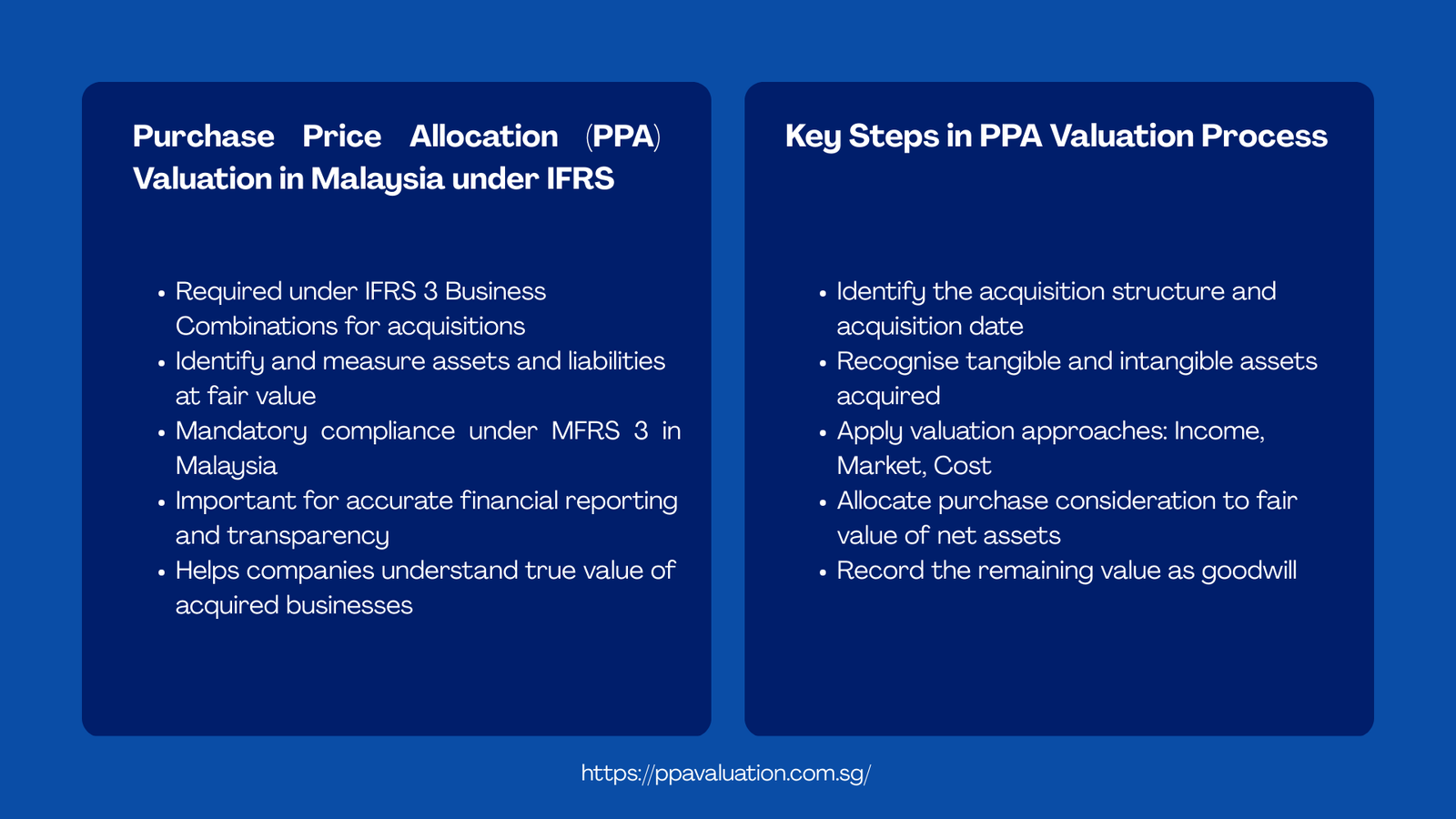
All business combinations are required to be acquired using IFRS 3. This implies that the acquirer has to determine the fair value of all identifiable assets and liabilities of the acquired party during the acquisition date, and any excess has to be categorized as goodwill (or in exceptional instances, gain on bargain purchase). The criterion is clear-cut and it cannot be merely the acquirer recording the acquired net assets at their current book values and that is it. There is a requirement of fair value measurement and the same is extended to intangible assets which, in fact, may not necessarily be present in books of the target at all.
In the case of Malaysian entities, domestic force is provided by adoption of the MFRS 3 that is identical to IFRS 3 word-for-word. Listed entities in Bursa Malaysia must comply, as well as those non-listed entities that use MFRSs. It implies that a Bursa-traded group that has purchased a Malaysian privately owned business which is a typical structure of the transaction should have a full PPA and implications that should be shown in the consolidated financial statements of the business. The penalties of non-compliance contain qualified audit opinions, restatements, and in case in listed entities, they can also face regulatory action by the Securities Commission Malaysia or Bursa Malaysia itself.
In addition to compliance, an effective PPA offers an actual strategic intelligence. The allocation process usually compels the management to place on the first occasion where the real value in an acquired business lies. When the relationship with customers can be used to assign RM 80million of a purchase price amounting to RM 100 million, then it should influence the retention planning after acquisition, resource allocation and integration plans. In this sense, Malaysia Purchase Price Allocation Valuation Experts not only auditors and regulators, but management groups eager to have a better understanding of what they in truth purchased.
The Five Major Steps in Purchase Price Allocation (PPA) Valuation in Malaysia under IFRS
The PPA should be auditable and structured. Although in each and every transaction there is always the nuances in it, there are the five basic steps that are used by the experienced practitioners in the exercise. Awareness of these steps provides the junior professionals with a sound psychological guide whenever they are dealing with any acquisition case.
The first one is to define the acquisition and the date of measurement. This includes making a close examination of the sale and purchase agreement (SPA) to determine what exactly has been purchased, shares, assets or both and ensuring that the accounting acquirer under IFRS 3. The acquisition date refers to the date at which the acquirer has taken charge and all fair values are calculated as at such date. This is important to get right since the economic conditions, interest rates, and performance of the business may vary of significant margin between signing and closing.
Second, determine and identify every asset and liability. This is, perhaps, the most judgmental step. Under IFRS 3, intangible property has to be recognised that fits the contractual-legal test (the property appeared due to a contractual right or a legal right) or the separability test (the property can be separated and sold, transferred or licensed). This in practice implies that practitioners need to go out of their way to examine the balance sheet of the target and enquire: Does it have customer contracts? Is there a recognised brand? Is the business proprietary or patented technology? Is there favourable lease agreement or rights to exclusive distribution?
Third, identify the fair value of every identified thing. This is based on valuation methodologies of three broad approaches namely the Income Approach, the Market Approach and the Cost Approach all of which are discussed in a subsequent section. The nature of the asset and availability of data and reliability of the derived estimate inform the decision made regarding the methodology.
Fourth, assign purchase consideration with all identified assets and liabilities. The total consideration, comprising of cash paid, deferred consideration, contingent consideration at fair value and equity instruments issued is matched against the amount of fair values of identifiable net assets. The surplus is goodwill; a deficit brings out a gain on bargain purchase, but this is not very common and must be examined keenly before being recognized.
Fifth, prepare, consult and involve the auditors. A PPA cannot be fully accomplished until it is accompanied by a comprehensive set of valuation report that identifies assumptions, methods, data sources and sensitivity test. The independent review work will generally be done by the appointment of their own valuation specialists by the auditors. Timely mobilization with auditors lowers chances of late night wrangles that may slow down signing of financial statements.
PPA Process: Four-Phase Overview —Purchase Price Allocation (PPA) Valuation in Malaysia under IFRS
| Phase | Action | Key Activities |
|---|---|---|
| Step 1 | Identify the Acquisition | Define the transaction scope, review SPA, confirm the acquirer and acquiree, and identify any contingent consideration. |
| Step 2 | Recognise & Classify Assets/Liabilities | Identify all tangible and intangible assets and liabilities — including those not on the acquiree’s books — that meet IFRS 3 recognition criteria. |
| Step 3 | Determine Fair Values | Apply appropriate valuation methodologies (Income, Market, Cost approach) to each identified asset and liability as at the acquisition date. |
| Step 4 | Allocate Purchase Price & Calculate Goodwill | Sum all identified fair values, compare to total consideration paid, and derive goodwill (or bargain purchase) as the residual. |
Valuation Methodologies Used in Purchase Price Allocation (PPA) Valuation in Malaysia under IFRS
One of the most technically challenging issues of PPA work is the choice of the right valuation methodology. No formula can be applied; a good practitioner reads the asset, reads the data, and chooses the method that would give the most credible and supportable fair value estimate. The following table is a brief description of the three primary methods and the areas where they are most used.
| Approach | Methods Used | Best Suited For |
|---|---|---|
| Income Approach | DCF, MPEEM, Relief-from-Royalty, With-and-Without | Intangible assets with identifiable cash flows (brands, customer lists, technology) |
| Market Approach | Guideline Public Company, Comparable Transactions | Tangible assets, goodwill cross-checks, and businesses with market comparables |
| Cost Approach | Replacement Cost, Reproduction Cost | Assets where economic benefit is hard to isolate (assembled workforce, specialised PP&E) |
The Multi-Period Excess Earnings Method (MPEEM) is the most widely used in the Malaysian context of valuing of customer relationships, which is in most cases the largest intangible in service and distribution business. The technique separates cash flows that can be linked to the individual relationship with customers by subtracting contributory asset charges (CACs) to all other assets that give rise to the cash flows. This will demand strong financial projections, a correct discount rate, and a justifiable customer attrition rate – all of which will necessitate a close tuning to the local market conditions.
The Relief-from-Royalty Method is conventional in terms of brand and technology valuation. It approximates the amount of royalty a business would pay hypothetically to licence the asset were it not to own that asset and capitalises on that stream of royalty. The choice of a suitable royalty rate in Malaysian business is not a trivial one: the practitioners normally consult the global list of royalty rates like RoyaltySource or ktMINE, and make a modification based on the specifics of the company including the brand recognition, geographic reach and the ability to maintain revenue. Professional Purchase Price Allocation Services Malaysia providers have been known to keep proprietary databases of regional royalty standard to enhance this analysis.
The Cost Approach applies best to assets whose economic value can be most closely represented by the cost of replacement or reproduction such as assembled workforce is the most common in Malaysia due to the significance of skilled technical groups in production and technology acquisitions. The assembled workforce, unlike other intangibles, cannot be recognised separately under IFRS 3 (it fails both the contractual-legal and the separability criteria), but its fair value is applied as a contributory asset charge in the application of MPEEM.
Typical Intangible Assets Identified in Purchase Price Allocation (PPA) Valuation in Malaysia under IFRS
|
Intangible Asset Category |
Valuation Method |
Typical Useful Life |
|---|---|---|
| Customer Relationships | Multi-Period Excess Earnings Method (MPEEM) | 5 – 15 years |
| Trade Names / Brand | Relief-from-Royalty Method | Indefinite or 10 – 20 years |
| Technology / Software | Relief-from-Royalty / Cost Approach | 3 – 10 years |
| Licences & Permits | Income Approach (incremental cash flows) | Contractual term |
| Non-Compete Agreements | With-and-Without Method | Contractual term |
| Order Backlog | Multi-Period Excess Earnings Method |
< 1 year |
Case Examples of Purchase Price Allocation (PPA) Valuation in Malaysia under IFRS
A typical example of the application of PPA to a real problem situation in Malaysia is to take a typical transaction situation involving a listed conglomerate and a mid-sized regional logistics firm. The target is twenty years old, with low fixed assets, and the majority of its revenue has consisted of a small group of long time manufacturing customers. RM 150 million will be considered as the purchase consideration; the net book value of the target is RM 40 million. Some acquirers are tempted to treat RM 110 million as goodwill and move on, but this practice will not go through an audit against MFRS 3.
An appropriate PPA, in this case, would probably include customer relationships (the greatest value component, as the client base has been long-term), a trade name (assuming the logistics brand has market recognition of its own), custom optimisation software of the routes (unless it is developed in-house and is not reported on the balance sheet), and possibly favourable warehouse lease arrangements in the event that the current market rents have shifted significantly. All these would be valued at fair value. Goodwill could be brought down to RM 50-60 million after allocation and the rest of the goodwill could be classified as finite-lived intangibles that are amortised over their useful lives. This carries a direct impact on the income statement implications – amortisation of intangibles that are newly identified can have a significant impact on post-acquisition earnings per share.
A privatized acquisition of a consumer healthcare company is another educative case. In this case, it is the brand that is nearly definitely the dominant value driver, and the target can have some additional value in its regulatory product registrations, a type of intangible that is extremely applicable in Malaysia owing to the importance of the National Pharmaceutical Regulatory Agency (NPRA). Contractual-legal condition is evident in the case of registered product licence because the individual should be identified and the individual valuation of the licence should be made. Experienced Strategic Purchase Price Allocation Consulting Malaysia the due diligence will involve direct interaction of the practitioners with the regulatory affairs team of the target to map the licence portfolio prior to the start of the PPA work.
Another theme that has been observed in Malaysian PPA engagements includes the need to begin early. Brought-in practitioners, who may be months after the acquisition date, can have a severe difficulty in rebuilding the economic environment, market conditions, and business performance as at the measurement date. Backfilling of data and re-interview of the management is time consuming and creates uncertainty. The practice of involving valuation specialists in the due diligence phase per se is the most appropriate, as the information collection should occur at the same time as the commercial and legal analysis.
Common Challenges in Purchase Price Allocation (PPA) Valuation in Malaysia under IFRS
| Common Challenge | Why It Arises | Practical Mitigation |
|---|---|---|
| Limited financial data | Private targets rarely maintain granular segment data | Request management accounts, pipeline reports, and customer contracts early |
| Intangible asset identification | Acquirers sometimes overlook assembled workforce, databases, or favourable leases | Conduct a structured intangible asset checklist against IFRS 3 criteria |
| Selecting discount rates | Malaysia-specific risk premiums and size premia are less published than in mature markets | Use Damodaran datasets, BNM yield curves, and comparable public company betas |
| Measurement period adjustments | New facts emerge after Day 1; IFRS 3 allows up to 12 months to finalise | Document all provisional entries clearly; set calendar reminders for finalisation |
| Auditor alignment | Auditors may challenge methodologies or assumptions late in the process | Engage auditors early, share draft reports, and document key judgements upfront |
Goodwill, Impairment, and Post-Acquisition Reporting After Purchase Price Allocation (PPA) Valuation in Malaysia under IFRS
After a PPA is completed, the goodwill figure obtained is then put into cash-generating units (CGUs) to be used on the annual impairment test under MFRS 136. It is at this point that the quality of the original PPA has long term effects. Provided that the original PPA was not well performed, that is, there was inflating goodwill due to the non-identification of intangibles, the acquirer will record a higher goodwill balance that will be later impaired. Risk of the goodwill impairment charge goes up accordingly when the business performance is lower than what had initially been projected.
The impairment testing of goodwill of a CGU entails the determination of the recoverable amount of the individual CGU – usually through a value-in-use test based upon discounted cash flow estimates – and the comparison of the recoverable amount with the carrying amount of the net assets of the CGU including goodwill. The discount rate and growth assumptions as well as CGU composition employed in this annual test are usually based on, or at the least, consistent with the original PPA model. The PPA model must not be viewed as a one time deliverable but a living reference document that is used to inform future reporting by finance professionals. Maintaining workpapers that have been effectively documented is not just something to practice well, but it is also necessary in the defence of the future impairment assessment by the auditors and regulators.
The skills that are most useful in the case of junior professionals entering the field are the ones that would enable them to critically evaluate the goodwill disclosures in published financial statements. The annual reports have to include the impairment testing methodology, key assumptions and sensitivity analysis of the listed companies in Malaysia. Careful reading of these disclosures, comparison of discount rates and growth rates and definitions of CGU across companies and time is a practical way to develop intuition on what value of assumptions is reasonable and where optimism bias may have infiltrated. This type of critical reading is the non-formal training of the psychologists aspiring to undertake positions in. Malaysia Purchase Price Allocation Valuation Experts in-house corporate finance units or companies.
Conclusion: Building Expertise in Purchase Price Allocation (PPA) Valuation in Malaysia under IFRS
Purchase Price Allocation is a technical, judgment-based exercise of the financial reporting, as well as one of the most significant. As the market of M&As is still developing in Malaysia, and the regulatory landscape is getting increasingly more advanced, the quality of the demand is increasing. Purchase Price Allocation Advisory Malaysia Services will only increase. In the case of junior to mid-level professionals, the payback of investment in knowledge of this field is reaped in a variety of professions: auditing, investment banking, private equity, corporate treasury, and business valuation advisory.
Read real deals is the best practical recommendation to those who are in the beginning. Upon announcement of the acquisition of a Malaysian public company, locate the following financial reports and investigate the PPA disclosures. See what intangibles were recognized, what procedures have been used, how the purchase price was disaggregated and what is the management explanation as well as accounting results of the same. With time these disclosures grow into a library of practical precedents which is not replicable in any textbook.
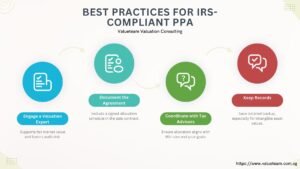
To an already practising person, the focus should be on the process discipline, i.e. involvement at an early stage, documentation, proactive alignment with the auditors, and creation of a defensible record of judgements that were made. Strategic Purchase Price Allocation Consulting Malaysia is not only about coming up with a figure; but it is about coming up with a well-thought out, well-supported response to the question every acquisition has to answer eventually where did the value come and how are we going to reflect it in the financial statements. Coming up with a good answer to that question on a regular basis is what makes the difference between a good PPA practice and an acceptable compliance.