Allocation of Acquisition Price in IT Product Companies
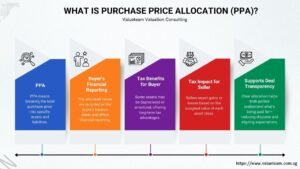
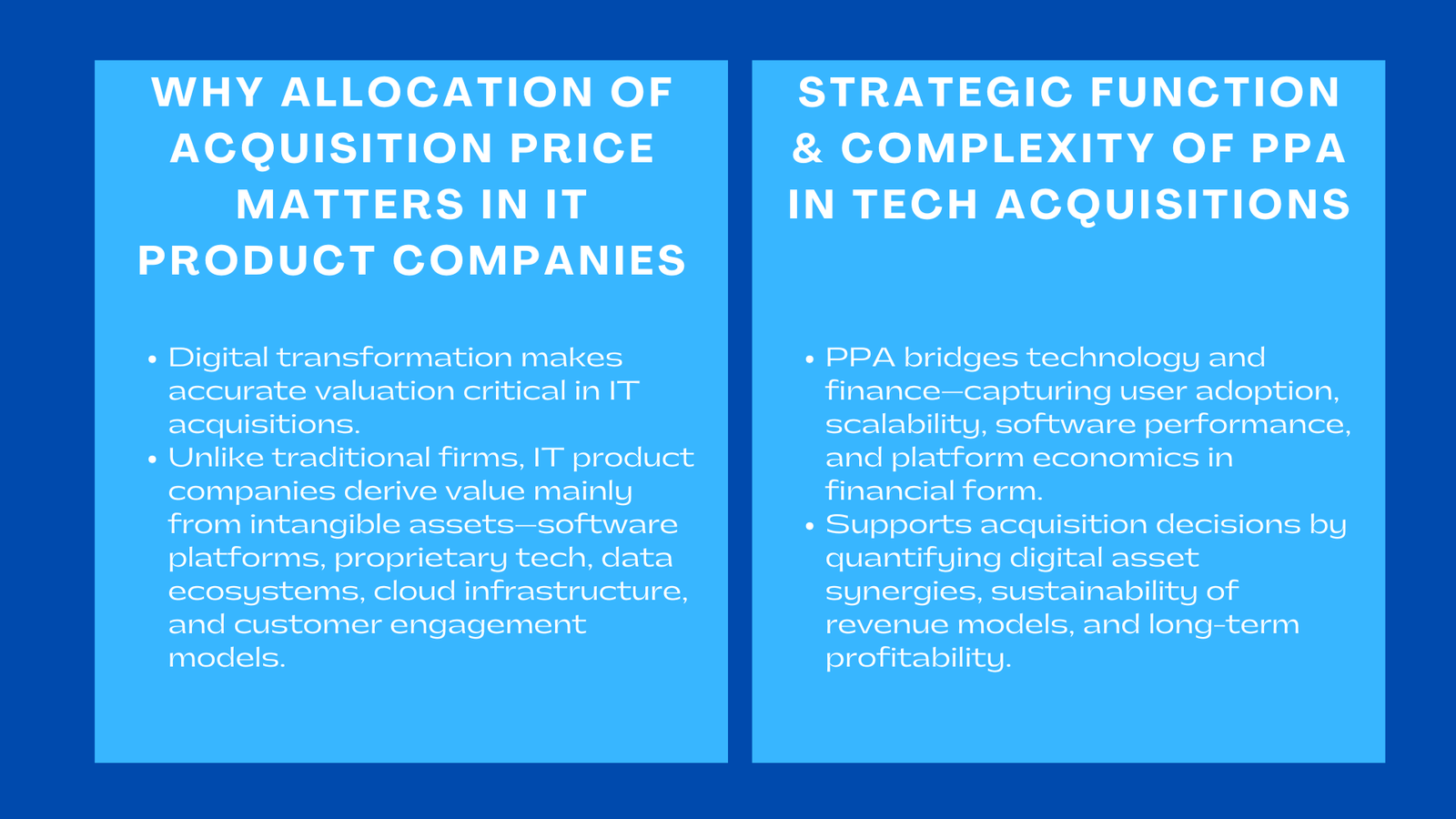
The apportionment of the purchase cost in IT products firms has emerged as a factor of higher priority in the contemporary financial sector as the digital transformation gains grandeur in sectors. Unlike the traditional businesses where the key economic value of the business is based on tangible assets and physical capital, the IT product companies value more intangible resources that include software platforms, proprietary technologies, data ecosystems, cloud infrastructure and customer engagement model. With these digital companies being acquired, investors, strategic corporate buying companies and financial institutions have to convert the complex technology capabilities of the acquired firms to ordered financial statements that satisfy the international accounting standards. Purchase price allocation (PPA) is a formalized tool, which combines both technological innovation and financial reporting and allows the acquirers to explain the relationship between digital assets and the long-term strategic payoffs and justify the price premium made by the acquisition in economic terms.
The blistering development of the digital economy has led to a situation in which technology takeovers have become part of the corporate strategy, especially when companies are interested in increasing the speed of innovation, establishing better competitive identity, or differentiating their products. IT product company purchase price allocation they often have large intellectual property, complex code bases, and platform-based revenue models, which are hard to model with conventional approaches of valuation. Since technological products change rapidly and users change behavior at lightning speed, PPA makes sure that the financial representation of these assets gives the true value of the strategy of the product. The intricacy in the digital assets will necessitate a multidisciplinary model that is a combination of financial modeling, technological evaluation, and regulatory insights to generate dependable and practical valuation findings.
Understanding the Strategic Role of Purchase Price Allocation
Creating a Bridge Between Technology and Financial Reporting
Purchase price allocation can be used as a transitional bridge which links the qualitative aspect of technology to finances in terms of financial measurement. In IT product enterprises intangible asset accounts will represent the greatest segment of enterprise value, but such asset accounts are not necessarily reflected directly in past financial reports. PPA offers a systematic methodology of recognizing, classifying, and capturing these intangible assets in order to make sure that the intangibles are considered as such in the post-acquisition financial reporting. In such a way, it aligns the evaluation of the technological potential of a company done by its investors with the accounting standards necessary to have transparent disclosure. The alignment guides the stakeholders on ways that software functionality, user adoption cycles, digital infrastructure, and platform scalability are converted into financial returns, a perspective increasingly emphasized in PPA valuation in M&A Singapore training.
Supporting Strategic Investment and Acquisition Decisions
A properly implemented PPA is not only in compliance with the accounting requirements, but it also proves the economic rationale of an acquisition. Acquisition rumors can obtain data on the reasonable cash flow potential of digital assets, sustainability of customer relations, and scalability of technology-based products due to specific valuation procedures. The ensuing disposition teaches the negotiation tactics, empowers the acquirer in price negotiations and assists in integrating after the acquisition. By doing so, PPA will convert the complicated technological characteristics into decision making information which helps an investor decide whether an acquisition is strategic to the overall strategy.
Navigating the Rising Complexity of Technology Transactions
The Effect of Evolving Digital Revenue Models
The nature of technology transactions is the existence of multi-layered structures of revenue schemes doubling the normal traditional business nature. The subscription model, tiers of license programs, usage-based pricing and freemium-to-premium typically demand analysts to tear down the revenue generating, sustaining, and growing processes. The value of these models should take into account customer behaviour interaction, engagement with the platform, and product update. Under the IFRS, the components of revenue may not be associated together and they should be measured at fair value which introduces an extra point of analytical difficulty which has to be dealt with cautiously. This complexity is further enhanced where the companies depend on hybrid monetization models which are a mixture of recurrent fees and consumption-based payments.
Limitations of Traditional Valuation Approaches
Traditional methods of valuation do not succeed in reflecting the depth of the digital outlook in products. Whereas discounted cash flow models and market comparison give a point of departure, they do not show aspects of user churn, adoption rates, retention groups, and long-term consequences of software upgrades. As an example, the risk profile of a cloud-based platform whose recurring revenue is growing rapidly is not the same as that of a perpetual licensing business that is generating similar revenue today. This disjuncture necessitates the use of technology-related measurements in the allocation process on the part of the analysts so that the value allocated is a good reflection of the dynamism of digital products.
Evaluating Core Intangible Assets Within IT Product Companies
Valuing Proprietary Software and Technology Platforms
The most valuable elements in the IT enhancing products businesses are commonly proprietary software, and technology resources. The software valuation needs the knowledge of the architectural robustness, scale, security protocols, frequency of updates, and adapting over time. The analysts will need to factor in the cost that will be needed to replicate the solution, the challenge with which the competitors will be able to recreate the technology, and the extent to which the software will be the key to generating revenues. This assessment can take the form of a conglomeration of qualitative technical assessments, and quantitative studies that approximate the financial advantage that can be ascribed to the software throughout its useful life. Quality and scaled software that can support a stable number of users is commonly given a high value because of its ability to pursue future profitability.
Assessing Customer Relationships and Recurring Revenue Potential
Another critical constituent of the intangible asset valuation is customer contracts and online relationships. Successful business models that are based on subscription require high customer loyalty, retention cycles and lifetime value. Evaluation of analysts needs to focus on the customer cohort resiliency, the probability of retaining the customers and the relevance of the digital touchpoints to long-term engagement. Valuation process encompasses the churn analysis, contract terms, pricing structure as well as customer segmentation. These relationships often constitute a good part of the value apportioned in most IT firms given that recurrent revenue designs can offer predictable and consistent value to the long run that is appealing to strategic purchasers and investors.
Evaluating Data Assets and Digital Infrastructure
The importance of proprietary datasets and digital infrastructure valuation increases in companies that use a considerable amount of data in the operations. Information, like user behavior logs, machine learning training images and operational knowledge, can be a source of competitive edge that is difficult to imitate. However, IFRS provides that only data assets that are identifiable and separable should be recognized and this would require careful analysis to ascertain their status in accordance with the criteria of recognition. Moreover, cloud infrastructure and platform ecosystems could also be considered as the source of intangible value as they allow attaining efficiencies in scale and sustaining high volumes of digital operations.
Reassessing Revenue Liabilities Under IFRS Reporting Standards
Understanding the IFRS Revaluation of Deferred Revenue
The occasion of deferred revenue is common in IT companies that deal with products because of relatively high rates of prepaid subscriptions and multi-year contracts. In IFRS the deferred revenue should be estimated at the price of meeting the pending obligation and not the amount indicated in the invoices. This usually leads to a negative adjustment in terms of the opening statement of financial position as well as probable profitability ratios. To get the fair value of deferred revenue at the date of acquisition, analysts are required to evaluate the fulfillment price, the service balance and anticipated margin.
Consequences for Financial Reporting and Earnings Trajectories
The re-assessment of deferred revenue has an influence in recognition of revenue in the post-acquisition periods which affects the reported earnings, cash flows and internal performance assessment. Business firms need to foresee and explain to the stakeholders in this regard how this change will reshape their monetary path. Since the deferred revenue revaluation can have significant impact on the profitability, it is the primary focus in PPA in technology based acquisitions.
Interpreting Goodwill and the Broader Economic Rationale
Identifying Strategic Synergies and Non-Separable Value Components
Goodwill is the figure that cannot be attributed to individual assets or liabilities and it displays the economic satisfaction of the larger economy that the acquisition was likely to produce. Goodwill in the case of IT product companies can take the form of expected synergies like faster innovations, digital ecosystems, the availability of new user groups, and upgrades in technological strengths. It entombs the future looks about the acquisition, which cannot be identified separately, but which contribute the formation with a determining role to the value generation in the long run.
The Role of Goodwill in Future Performance Measurement
The goodwill is not amortized but is impaired annually, and thus, it is a long-term indicator of the acquired firm of the expectations that the acquirer has of the future performance of the acquired firm. Its size is usually reflective of the belief that the acquirer had on the scaling ability of the technology, the development team, and the envisaged course of market growth.
Applying Purchase Price Allocation Across Investment Practices
Enhancing Valuation Precision in M&A Transactions
PPA is the analytical basis of purchasing justification in the case of technology-driven mergers and acquisitions. The corporate advisors and investment bankers use the PPA frameworks to document the logic of valuation, negotiate terms of transaction and compile client ready reports. Such reports should prove introduction of intangible assets to back the price of acquisition which enhances credibility of valuation to the executives, auditors and regulators.
Supporting Private Equity Value Creation Strategies
PPA is used by the private equity firms to know the role that the intangible assets play in the financial performance of the portfolio companies. Software platform, customer base, and data infrastructure identification, valuation provides the investors with an opportunity to estimate the operational enhancements and track revenue stability as well as exit preparedness. PPA also assists the firms in areas where they can improve their operations to unlock the value.
Addressing Valuation Uncertainty in Venture Capital Investments
New IT companies pose major issues over valuation because of little operating background and unstable revenue forecasts. PPA offers an ordered system of integrating the probability-weighted cases, milestone-based performance indicators, and constrained revenue modeling. This can be used to provide more insight into why venture capitalists can reasonably justify their valuations and explain to the limited partners why they are valid.
Strengthening Strategic and Analytical Thinking Through PPA
Adopting a Forward-Looking Approach to Digital Valuation
Purchase price allocation helps to motivate the valuation professionals to develop a prospective analytical attitude. It needs an in-depth insight into the dynamics of digital trends that influence future sources of revenue, including cloud implementation, AI solution implementation, and behavioral analytics. The mentioned technique will prioritize the current financial statements to the dynamic forecasts that embrace the changes in technology and the disruptive influence of the market.
Interpreting Digital Performance Indicators with Analytical Rigor
The digital performance indicators that need to be incorporated into the valuation models by analysts include churn, retention, product interaction, and platform scalability. The integration will enhance the level of analytical rigor because it requires professionals to incorporate financial skills with knowledge in technology to make sure the valuation results will mirror the real economics of digital businesses.
Communicating Complex Valuation Outputs to Stakeholders
Translating Technical Analysis Into Executive-Level Insights
The businesspeople on the boards of directors in charge of the company and executives might be lacking the technical expertise to read complicated valuation models. Effective communication can be done clearly and exhaustively so that the findings of valuation are presented in a format that will assist in decision-making. Transforming raw analyses to strategic insights which the stakeholders can relate to is provided by effective communication.
Promoting Transparency and Audit Readiness
Effective communication practices are also stimulatory of audit preparedness in that the valuation assumptions, methodologies, and outcomes are written in detail and uniformly. This openness will enhance trust in the stakeholders and ease the process of regulatory oversight.
Integrating Analytical Technology Into the Valuation Process
Leveraging Automation, Data Processing, and Programming Tools
The developments in the technology of analysis have changed the nature of conducting PPA. Tools like automation tools, Python programs and enhanced excel models help an analyst to dig a considerable amount of customer and usage data faster and more accurately. These tools minimize the possibility of human error and help to more dynamically model situations.
Connecting Valuation Models with Real-Time Analytics
Connecting the valuation systems to the data analytics systems would provide PPA with a chance to sustain relevance despite the fluctuations in customer behavior, platform performance, and market conditions. Digital metrics can be monitored in real-time to allow companies to revise their assumptions more often and also refine their conclusion of valuation.
Institutional Advantages of Rigorous Purchase Price Allocation
Enhancing Reporting Quality and Strategic Assurance
A strict PPA system makes the financial reporting accurate and makes the institutions confident in the valuation process. A combination of implementing digital performance metrics and adopting them in accordance with the requirements of IFRS will allow organizations to provide the financial statements that are actually based on the business realities and priorities.
Building a Culture of Analytical Discipline
Companies that practice overall PPA systems have a culture which is based on analytical accuracy and strategic acumen. The culture helps in promoting dialogue within the company, increasing the extent of interdepartmental cooperation and aids in facilitating optimal decision making in the long-term.
Conclusion to Allocation of Acquisition Price in IT Product Companies
Purchase price allocation is now inevitable in an age where the business world around the globe is being influenced by digital innovation that requires consideration of the actual economic value of the IFRS reporting IT startups product companies. PPA uses translation of technological assets into organized financial metrics, which help in making sound decisions on mergers, acquisitions as well as investments. The relevance of consistent, progressive, and analytically sound forward-thinking PPA can only increase in the digital economy which is still developing. To investors, strategic acquirers and financial professionals it is vital to get the art of PPA to enable them to sail through the complexity of technology-driven valuation and attain long-term success in the sea.