Business Valuation Allocation for Marketing Startups
Marketing startups—ranging from digital advertising agencies and performance-marketing firms to content creation platforms and data-driven martech companies—operate within dynamic ecosystems where intangible assets dominate business value. Unlike traditional service companies, marketing startups derive economic strength from creative intellectual property, client relationships, proprietary data analytics tools, brand positioning, and scalable digital capabilities. When these startups undergo acquisition, consolidation, or strategic investment, the allocation of the purchase price becomes essential to determine how value is distributed across identifiable assets and goodwill. IFRS 3 provides the framework for allocating the purchase price, ensuring the startup’s financial statements reflect the economic reality underlying creativity, technology, and client-driven business models.
As marketing startups attract investors seeking high-growth, data-centric businesses, compliance with IFRS 3 reporting becomes increasingly important. Marketing acquisitions often involve complex intangible assets such as digital platforms, marketing automation systems, content libraries, and proprietary algorithms that must be fairly valued. IFRS 3 requires acquirers to identify and measure acquired assets at fair value, assign the appropriate portion of the marketing startup purchase price allocation, and systematically recognize goodwill. This process ensures transparency in financial reporting, helps investors understand the true economics of the transaction, and supports long-term post-acquisition integration.
Why IFRS 3 Reporting Has Become Critical in Marketing Sector M&A
Linking Creative, Technological, and Analytical Value to Financial Reporting
Enhancing Investor Confidence in High-Growth, Innovation-Driven Acquisitions
In marketing-sector M&A, buyers often pay premiums based on anticipated synergies, scalability, and access to new client networks. Purchase price allocation ensures that these expectations are reflected appropriately by assigning value to both identifiable intangible assets and goodwill. The clarity gained through PPA strengthens investor trust, supports negotiation, and clarifies integration priorities related to technology alignment, brand consolidation, and talent retention.
IFRS 3 Complexity in Marketing Startup Transactions
Challenges in Valuing Creative and Digital Assets
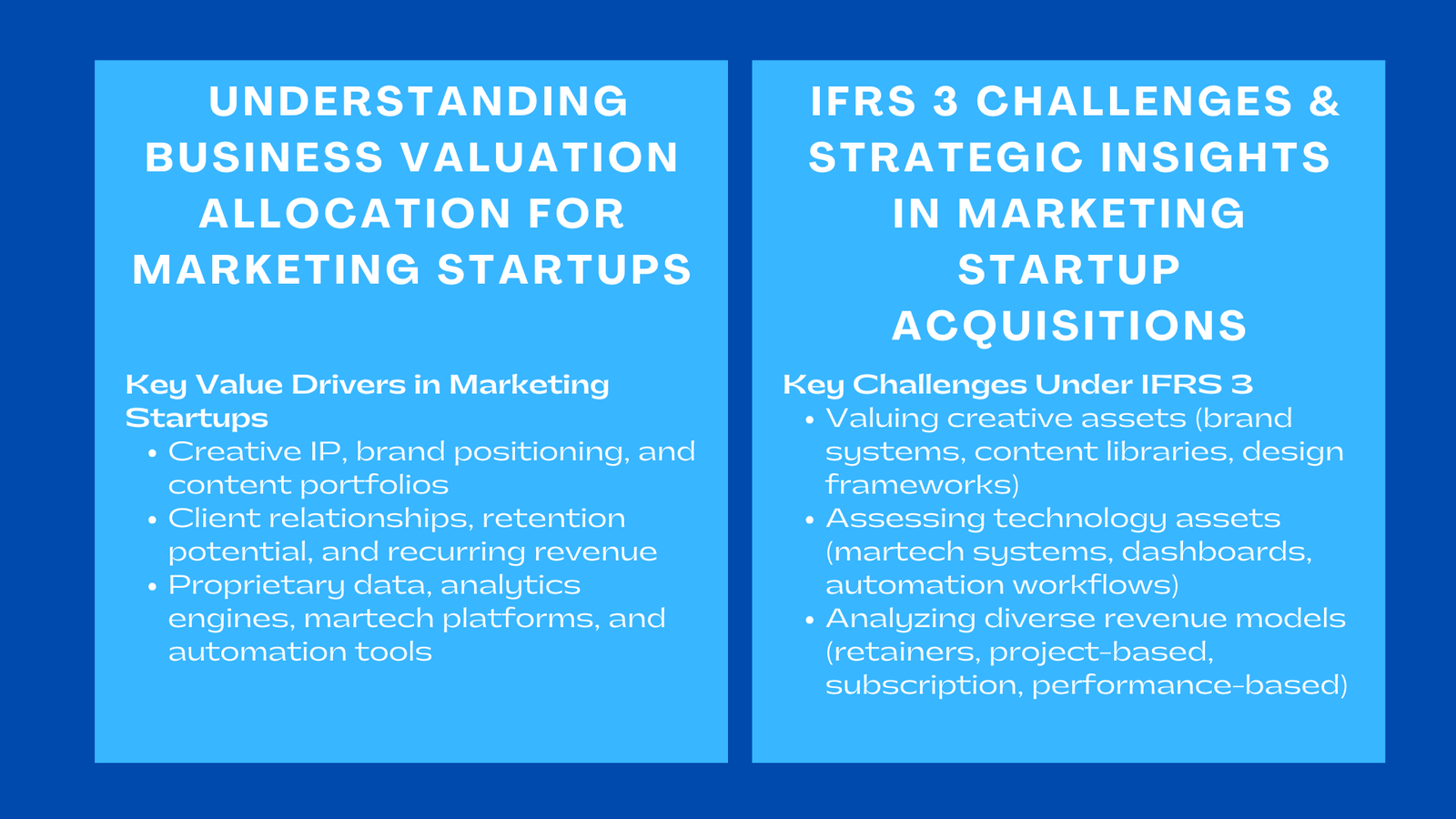
Marketing startups often possess asset portfolios that are complex and difficult to quantify. Creative assets such as design frameworks, branding systems, and digital content libraries must be valued based on their economic contribution rather than their production cost. Technological assets such as martech systems, campaign performance dashboards, analytics engines, and automation workflows add further complexity. Under IFRS 3, these assets must be fair-valued, requiring robust methodologies that capture their ability to drive future revenue.
Revenue Models and Client Structures that Influence Valuation
Marketing startups may operate under retainer arrangements, project-based fees, subscription services, affiliate models, or performance-based compensation. Each model influences predictability, risk, and the timing of cash flows. IFRS 3 requires analysts to examine client diversification, churn rates, revenue seasonality, and contract duration to understand how these factors contribute to asset valuation. This level of granularity ensures PPA outcomes align with the startup’s business dynamics.
Identification and Valuation of Key Intangible Assets in Marketing Startups
Client Relationships and Recurring Revenue Potential
Established client relationships represent one of the most valuable intangible assets in marketing startups. The strength of these relationships affects customer lifetime value, engagement frequencies, and project renewal likelihood. IFRS 3 requires the valuation of customer relationships if they are identifiable and generate measurable economic benefit. Analysts must consider client concentration risks, agency-client tenure, and projected retention rates.
Brand Equity, Creative Intellectual Property, and Content Portfolios
A marketing startup’s brand positioning—including its market authority, creative reputation, and industry influence—can significantly impact acquisition value. Creative IP, such as proprietary brand frameworks, market research databases, standardised content templates, and design identities, must be evaluated based on future benefits rather than historical production effort. Under IFRS 3, these components can be recognized as intangible assets if they meet identifiability criteria and provide future economic advantages.
Technology Platforms, Analytics Systems, and Martech Infrastructure
Modern marketing startups rely heavily on martech platforms, CRM integrations, audience analytics dashboards, SEO tools, and automation systems. These technological assets form part of the firm’s competitive advantage, enabling efficient campaign execution and data-driven insights. IFRS 3 requires their valuation based on usefulness, reproducibility, and obsolescence risk. Analysts must assess software architecture, code quality, scalability, and integration dependencies to determine fair value.
Evaluating Tangible Assets and Human Capital Considerations
Office Space, Creative Equipment, and Physical Resources
Although marketing startups are largely digital, tangible assets still contribute to operations. Workstations, audiovisual production equipment, editing suites, collaboration spaces, and studio environments must be valued at fair market value. These assets often represent a small percentage of acquisition value but still require proper allocation.
Understanding Human Capital and Its Influence on Goodwill
Marketing startups depend heavily on creative teams, strategists, analysts, influencers, and campaign specialists. While human capital cannot be recognized as an intangible asset under IFRS 3, its importance is reflected in goodwill. Employee expertise, brand ambassadors, creative leadership, and organizational culture influence the portion of the purchase price that cannot be individually allocated and thus forms part of goodwill.
IFRS 3 Treatment of Contract Liabilities and Deferred Revenue
Reassessing Prepaid Campaign Fees and Contractual Obligations
Marketing startups frequently receive prepaid fees for ongoing campaigns, annual retainers, or subscription services. Under IFRS 3, these contract liabilities must be fair-valued based on the cost of fulfilling remaining obligations. Analysts must assess project timelines, deliverable complexity, expected margins, and cost-to-complete estimates to determine the fair value of deferred revenue.
Impact on Post-Acquisition Performance and Revenue Recognition
Deferred revenue adjustments can influence post-acquisition profit recognition, particularly if the startup has substantial prepaid marketing packages or multi-phase campaign commitments. Through IFRS 3 reporting, acquirers ensure that revenue recognition reflects the economic substance of services rather than invoice timing. This improves financial accuracy and supports long-term performance evaluation.
Understanding Goodwill in Marketing Startup Acquisitions
Capturing Synergies, Creative Capabilities, and Market Expansion Potential
Goodwill represents the portion of the purchase price not allocated to identifiable assets. In marketing startups, goodwill often reflects future synergies such as expanded service offerings, improved brand visibility, cross-client penetration opportunities, and enhanced digital capabilities. Goodwill is also influenced by talent excellence, innovative processes, and strategic integration benefits between the acquirer and the acquired firm.
Monitoring Goodwill Through Performance Metrics and Market Dynamics
Because goodwill must undergo annual impairment testing, it is important for acquirers to monitor key indicators such as client renewal rates, creative performance, margin stability, and competitive positioning. Declines in market relevance or human-capital turnover can affect goodwill recoverability. Monitoring ensures that the expectations embedded in goodwill remain aligned with market realities.
Applying Purchase Price Allocation Across Marketing M&A Scenarios
Consolidation Among Digital Agencies and Creative Boutiques
The marketing industry has seen increased consolidation as larger agencies acquire smaller creative boutiques, influencer networks, and performance-marketing firms. PPA analyses help determine the value contributed by each specialized entity, clarifying integration strategies and supporting unified IFRS reporting.
Acquisitions of Martech Startups and Data-Driven Marketing Platforms
When marketing startups include proprietary software, AI-driven analytics, or audience-data frameworks, the allocation of purchase price becomes more complex. The valuation must incorporate technology lifecycles, codebase strength, competitive differentiation, and scalability. IFRS 3 guidelines ensure that these technology assets are measured accurately and consistently.
Private Equity Investments in Marketing Growth Companies
Private equity investors often acquire marketing startups for rapid scaling, international expansion, or platform consolidation. PPA supports investor decision-making by mapping the value of relationships, creative IP, and technology assets against future growth potential.
Strengthening Strategic and Analytical Thinking in Marketing Valuations
Building a Long-Term View of Client Behavior and Market Trends
Purchase price allocation encourages analysts to look beyond historical performance and understand long-term demand drivers, including shifts toward digital advertising, data privacy regulations, and omnichannel marketing integration. This forward-looking perspective aligns valuation outcomes with the startup’s strategic opportunities.
Applying Analytical Discipline to Creative and Digital Metrics
Valuation requires understanding campaign effectiveness, client profitability, audience engagement analytics, conversion performance, and digital retention. Integrating these components into PPA enhances accuracy and ensures IFRS compliance within creative environments where financial implications may be less intuitive.
Communicating PPA Results to Marketing Sector Stakeholders
Translating IFRS 3 Findings Into Clear Strategic Implications
Marketing founders, creative teams, and agency executives often focus on innovation and creative output rather than technical accounting. Effective communication of PPA outcomes helps stakeholders understand how intangible value is measured, how goodwill is determined, and how IFRS 3 influences reporting. This clarity supports trust and ensures alignment between creative goals and financial obligations.
Ensuring Transparency, Governance, and Audit Readiness
A well-documented PPA strengthens governance practices in marketing startups transitioning into larger corporate structures. Transparency in valuation assumptions, methodologies, and IFRS implications ensures audit readiness and supports compliance with increasingly stringent regulatory environments.
Integrating Technology and Analytics in Marketing Startup PPA
Using Campaign Analytics, CRM Data, and Martech Insights
Digital marketing startups collect extensive data on client activity, campaign effectiveness, audience segmentation, and engagement behavior. Integrating these datasets into PPA enhances valuation accuracy by reflecting real drivers of performance. Advanced analytics help determine customer lifetime value, churn probability, and expected future contributions.
Leveraging Automation and Dynamic Financial Modeling
Modern valuation tools allow for dynamic scenario modeling that reflects evolving market conditions, shifting budgets, and emerging technology trends. Using automation strengthens the reliability of PPA outcomes and ensures that IFRS reporting stays aligned with the fast-paced digital marketing environment.
Institutional Advantages of Rigorous PPA in Marketing Startup Deals
Strengthening Financial Reporting Quality and Strategic Decision-Making
Rigorous purchase price allocation supports high-quality reporting and strategic clarity by connecting intangible drivers of marketing success to financial outcomes. This strengthens long-term planning, supports integration strategies, and enhances the startup’s readiness for future investment or expansion.
Promoting Analytical Culture in Creative-Led Organizations
Consistent application of PPA fosters analytical precision within marketing firms traditionally driven by creativity and intuition. This culture encourages balanced decision-making, where creative innovation aligns with financially sound strategies and IFRS-compliant reporting standards.
Conclusion to Business Valuation Allocation for Marketing Startups
As marketing startups continue to scale through innovation, data analytics, and digital transformation, purchase price allocation has become a central component of understanding their economic value. IFRS 3 reporting guide provides the structure needed to translate creative potential, client relationships, and technological capabilities into measurable financial components. For acquirers, founders, and investors, mastering marketing startup purchase price allocation strengthens transparency, enhances strategic insight, and supports long-term success in a competitive, rapidly shifting industry landscape.