Certified Hospitality Business Valuation Course
Allocating Purchase Price for Cafés and Restaurants
Introduction to Certified Hospitality Business Valuation Course
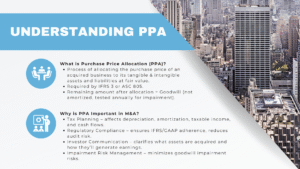
The food and beverage (F&B) industry is a very vibrant and competitive industry at the moment. Investors who purchase cafes, restaurant chains, or specialty restaurants would not only need to be efficient in their operations but also in the accounting of the financial and non-financial assets. Purchase Price Allocation (PPA) is one of the most important features of post-acquisition reporting the process of recognizing, measuring, and determining fair value of all the acquired assets and liabilities. In the case of cafes and restaurants where goodwill, brand equity, and customer loyalty may be the key drivers of value than physical assets, proper allocation becomes extremely important.
This paper is specifically on valuation and accounting of intangible assets when valuing and accounting the intangible assets on PPA in the case of F&B business. It discusses how operators of cafes and restaurants can determine fair value measurements to meet the special nature of their industry without breaching the International Financial Reporting Standards (IFRS).
1. Purchase Price Allocation: Strategic Role in F&B Acquisitions.
1.1 The importance of PPA to Hospitality and F&B Deals.
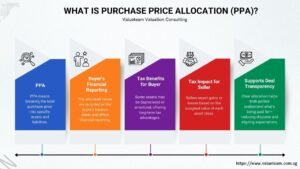
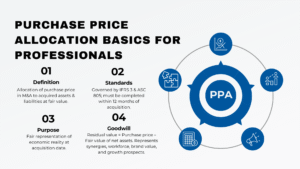
When the acquirer is involved, the buyer does not just seek to acquire an already existing operation but capture its brand image, location advantage, and consumer base. PPA is used to bridge the gap between payment amount (the purchase price) and the ownership (the fair-valued assets and liabilities). In the case of cafes and restaurants, this exercise transcends compliance, as it has implications on taxes, future impairment tests and even their perception to investors.
A well-prepared café purchase price allocation ensures transparency and helps management identify which parts of the business generate the most value. As an illustration, a restaurant brand with a reputation of high quality dining can derive an important value in its trademark, whereas customer relationship and franchise rights can be of a high value to a coffee franchise. Effective distribution also enhances the bargaining with the stakeholders having a realistic view of asset quality and sustainability.
1.2 Intangible Value in a Cafe or Restaurant Acquisition.
Cafes and restaurants do not possess much physical assets as opposed to manufacturing or logistics business. A large portion of their value is based on intangible elements like brand reputation, menu development, customer service, and goodwill that is developed based on location. These assets may serve as a guide when developed through PPA as they offer a platform where strategic decisions can be made after acquisition whether it be expansion, franchise development or rebranding.
2. Finding and Recognizing Intangibles in F&B Businesses.
2.1 Valuation of a brand and trademark shall also be done as per
One of the major actions during the allocation process is the brand valuation of the restaurant or cafe. According to IFRS 3 the brand can be classified as an identifiable intangible asset under which it can be separated out of the business or is a result of contractual rights. This valuation is often performed in the Relief-from-Royalty Method which approximates the current value of the avoided royalty payments which are otherwise to be paid to license the brand.
An example is that when a coffee chain is being acquired using a well-known name and the acquirer has a customer who has a following, then a high percentage of the purchase price can be assigned to the fair value of the brand. It is a valuation that reflects the long-term economic advantage of holding the brand itself as opposed to paying a brand license fee periodically.
2.2 Customer Relationships and Customer Loyalty Programs.
Those restaurants that demonstrate good customer retention measures as repeat customers, loyalty club, or delivery associations have intangible assets. Such relationships can be appreciated under Multi-Period Excess Earnings Method (MPEEM) that isolates the income produced on the repeat customers with the support of the asset returns subtracted.
An example of a fast-casual restaurant that has developed recurring online order base using a mobile app can show customer relationship value, which can be quantifiable. This information assists the investors to evaluate whether the stability of the revenue of the acquisition is worth the premium paid.
2.3 Franchise Rights and Non-Compete Rights.
In multi-location F&B businesses, value is significantly distributed among franchise or operating rights. These rights under the IFRS are recorded at fair value in case they have quantifiable economic benefits. Non-compete agreements are also important where they may ensure that the competitors are not allowed to venture into the same market region or change the same brand name.
A buyer of a local cafe franchise can, thus, attribute dissimilar values to franchise rights, supplier contracts and territorial exclusivity. These elements are capable of reflecting high potential of long-term earnings.
3. Physical Properties and Leasing.
3.1 Physical Economic Resources in F&B Operations.
Intangible assets tend to prevail in the valuation in the F&B, but tangible elements still need to be valued. The leasehold improvements, furniture, and kitchen equipment have to be valued either by cost or market methods. The items, however, tend to carry lower enterprise value than brand or goodwill.
As an illustration, two restaurants of significantly different equipment valuations can be in the same city with one holding a great location, with a strong brand. This gap highlights the fact that physical assets, although required, do not determine competitive advantage in F&B industry.
3.2 under IFRS 16 Lease and Rental Agreement.
A vast majority of cafes and restaurants rent their buildings and lease accounting is an important component of PPA. Under the IFRS 16, acquirer should be able to recognize right-of-use assets and lease liabilities at fair value. Analysis of these leases assists in knowing whether leasing terms are good in relation to the market conditions.
A cafe which is subject to rent conditions that are below-market and long-term, such as that of a cafe, has a good intangible lease property. On the other hand, a high lease can decrease fair value of total net assets obtained.
4. Goodwill and Post-Acquisition Reporting.
4.1 Goodwill Calculation and Management.
Goodwill is the amount of premium over fair value of identifiable assets and liabilities and in many cases, this is based on future growth potential and synergies or the value of a workforce that has not been recognized. In the case of restaurants, goodwill may be based on anticipated growth prospects, effective supply chains or a management team that has been in place.
Under IFRS, no amortization of goodwill is provided and impairment test is done annually. Frequent review of the goodwill recorded is to ensure that the goodwill recorded remains realistic in the performance of the business. In case of decrease in sales or a drop in traffic by the customers, an impairment charge might be required.
4.2 Integration and Performance monitoring.
After acquisition, it is possible to integrate financial and operational systems and this enables the management to monitor the performance of allocated assets. In other words customer growth should have a correlation with the brand valuation whereas customer relationship value should have association with retention rate. By making continuous monitoring, it is possible to establish whether the assumptions in the valuation can be assumed to be valid over time.
5. Experiential Problems in Cafe and Restaurant PPA.
5.1 Volatility and Sensitivity to the Market.
The preferences of consumers in the F&B industry are easily changed because of shifting dietary habits, emerging competition, or economic conditions. Such changes complicate the process of predicting cash flows – and hence valuing intangible assets. These risks can be addressed with sensitivity analysis and scenario modeling.
5.2 Regulatory and Tax implications.
Tax treatment to intangible assets, amortization or impairment of goodwill may be different in each jurisdiction. Aligning F&B IFRS accounting tips with local tax guidelines ensures compliance and minimizes disputes with auditors or tax authorities.As an example, certain markets permit amortization of special intangible assets, tax wise, yet IFRS does not permit costly intangible assets to be amortized in the financial statements. The awareness of these differences may impact acquisition strategy and finance modelling.
6. Strategic Value of a Correct Allocation.
A precise PPA improves clarity, aids in making a wise decision, and grants trust to the stakeholders. To investors and acquirers operating in the F&B sector, the allocation process provides understanding on the strengths as an operation and long-term brand potential. An accurate estimation of customer loyalty, franchise rights, and brand equity is also useful in determining major performance drivers and potential new growth.
Further, proper allocation of purchase price sets a good base of post-acquisition integration, performance measurement and impairment testing. It makes sure that the reported financial statements are based on the real economic picture of the acquisition, which will increase the degree of credibility among both the regulator and investors.
Conclusion
To invest in the purchase of cafes and restaurants, there must be a balance between technical rigor, financial acumen and expertise in the sector. Using the fair value of intangible assets like brand, customer loyalty and franchise rights, the acquirers can align their financial reporting with both the IFRS standards and business strategy. An inclusive cafe purchase price allocation that is backed by trusted F&B IFRS accounting hints not only helps in boosting compliance but will also offer a strategic map that can help the business grow long term in a fast-evolving food and beverage environment that is already rife with competition.