Purchase Price Split in Fitness & Yoga Studio Deals
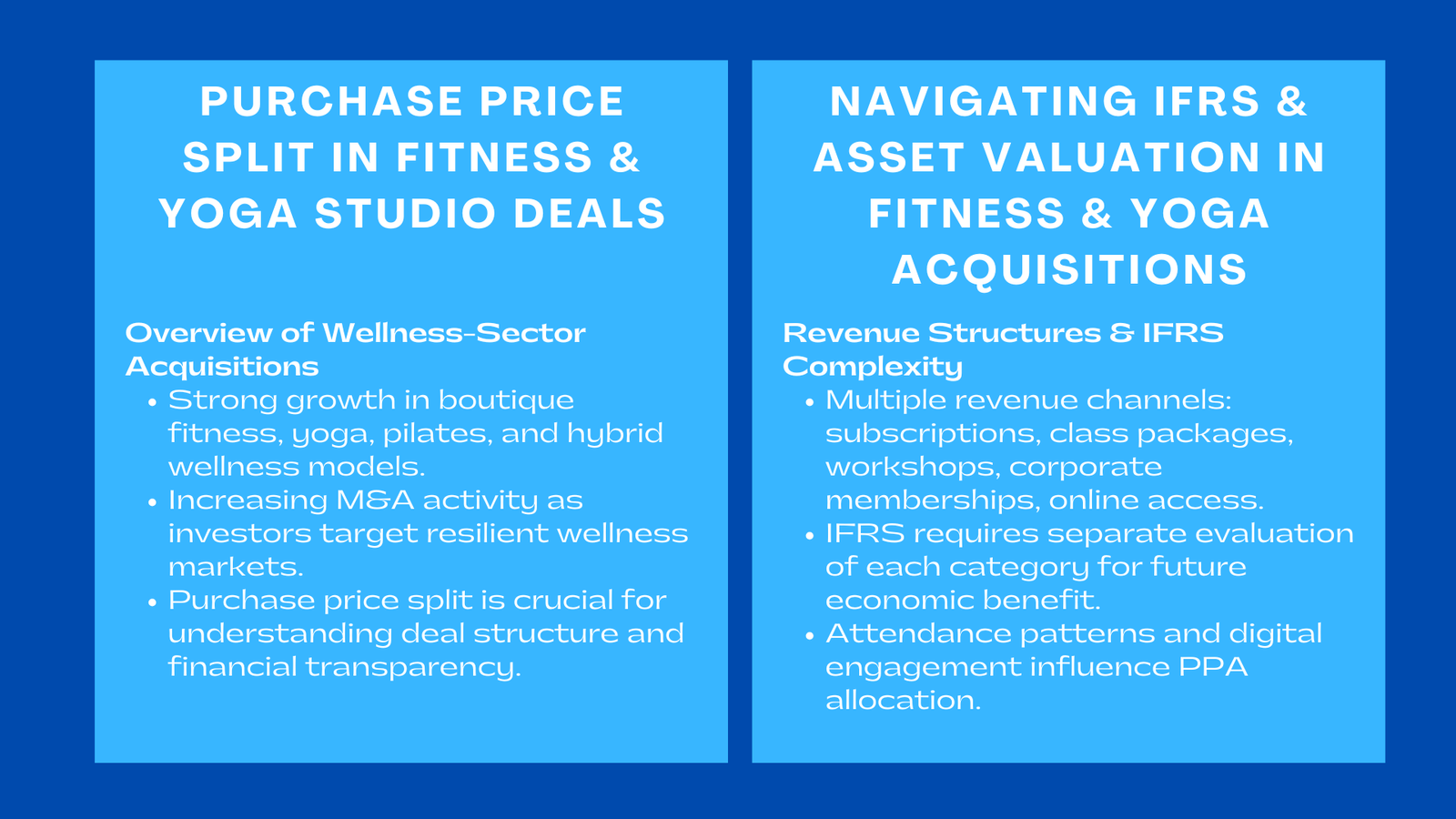
Wellness business has grown exponentially utilizing boutique fitness studios, yoga studios, pilates studios, and individual training centers and mergers and acquisitions are becoming more prevalent. The assignment of the purchase price is an extremely significant part of the analysis of financial structure of such offers as the number of investors, looking to find opportunities in the health and wellness segment increases. Gyms and yoga studios are dependent on unquantifiable values such as brand culture, loyalty, reputation of the instructor, location benefits and interactivity of the community that cannot be readily categorized on regular balance sheets. The purchase price allocation by the IFRS helps in the identification, valuation and accurate representation of the representations of these intangible drivers in the financial reporting after acquisition.
As most of the fitness studios are shifting to subscription-driven business models, digital delivery hybrid, and wellness community ecosystems, the IFRS reporting has gained more importance. Investors and private groups as well as the wellness brands need an explanation of the extent of the acquisition price that is to be allocated to tangible assets, intangible assets, deferred revenue, and goodwill. Fitness studio purchase price allocation gives an ordered, open methodology of examining these elements. With a more advanced and data-based approach to wellness investments, IFRS purchase price allocation can guarantee consistency, credibility, and accuracy in reporting in the long term.
The Strategic Purpose of Purchase Price Allocation in Fitness & Yoga Deals
Transforming Operational Fitness Value Into Financial Representation
The definition of success in the case of a fitness or yoga studio usually depends on the aspects of the member loyalty, the experience of the instructor, the variety of programs, the culture of the classes, and the brand. However, the aspects are intangible and they have to be converted into economic worth at the time of acquisition. PPA gives a systematized approach of capturing such aspects in such a way that the financial statements are a true representation of the operational reality of the studio. The allocation process assists in differentiating between the recurring membership revenue, the strength of the brand that the studio uses as well as the economic contribution of the model of its service delivery, a process that mirrors the structured analytical rigor found in a financial instruments valuation under IFRS 9 Singapore course.
Strengthening Investor Confidence and Deal Justification
Investors will use PPA in order to comprehend the reasons behind paying a premium of a wellness or yoga studio. An effective allocation demonstrates the role of customer retention rates, used capacity in classes, waitlists, program uniqueness, and online involvement in profitability in the long term. By performing thorough PPA analysis, buyers will be able to support acquisition prices, negotiate better, and develop strategies of integration that would align the expectations on financial considerations with the wellness-oriented brand values.
Navigating IFRS Complexity in Wellness-Sector Transactions
Unique Revenue Structures and Membership Models
The models of revenue generation used in fitness and yoga studios are not similar to the normal consumer-service businesses. Monthly subscriptions, classes packages, drop-in charges, workshops, corporate memberships, and combined online subscriptions have different patterns of revenue recognition. That is because under the IFRS, every single category is to be evaluated as it is contributing to the future benefits to the economic state. These variations make PPA more complicated and entail the necessity of analysts referring to physical attendance patterns and online interaction indicators.
Operational Sensitivities and Location-Driven Risk
Studios find themselves relying on certain areas like neighborhoods, demographic behaviors, specific time of the day when people like their workouts, and also the competition. The stability of revenues may change with seasonal changes to fitness, changes to instructors, or community outreach activity. According to the IFRS such factors will be used in the estimation of the life of intangible assets, their expectations of goodwill and probability of impairment. This is because wellness consumption is dynamic, requiring a profound knowledge of the operational and market environment during the process of PPA.
Identification and Valuation of Key Assets in Fitness & Yoga Studios
Evaluating Tangible Assets: Studio Infrastructure and Equipment
Fitting rooms have obvious equipment in the form of yoga mats, pilates machines, weights, mirrors, audio system and furniture, but this frequently makes up very little of the overall value. The tangible assets under the IFRS should be valued at fair market value, consideration of the remaining useful life, condition, and replacement cost. Ventilation systems, ventilation system and lighting, floors and platforms where instructors deliver lessons are also part of the studio setting and have to be considered.
Valuing Intangible Assets: Membership Base, Brand Identity, and Instructor Reputation
Intangible assets have the greatest driver of value in wellness studios. Recurring revenue potential is determined by membership bases, which are mostly dependent on renewal behavior, attendance rates, community loyalty and engagement on a digital platform. The reputation of the instructor is important especially among the setting of yoga and boutique fitness as certain teachers have regular followings. Brand identity also helps to attract the premium price and the differentiation in the market. In the IFRS, it is necessary to identify such intangible assets, separate them, and measure them; it is necessary to analyze customer groups, use rates in the program classes, and the dynamics of demand.
IFRS Treatment of Deferred Revenue and Member Prepayments
Reassessing Membership Credits, Class Packages, and Prepaid Services
Numerous studios do offer prepaid class packages, automatic renewal membership or wellness packages which generate uncollected revenue balances. Under IFRS, a company that faces a liability is required to be valued at the cost to perform the remaining obligation instead of on its face value as per the invoice. This implies that studios have to consider the unused credits in classes, packages and the capability of providing classes in the future. The allocation procedure should be based on the ability of the studio to operate and provide the services that are symbolized by these prepayments.
Impact on Post-Acquisition Revenue Recognition and Earnings Stability
The deferred revenue revaluation may have the impact of driving anticipated revenues in the after acquirement months. Such changes will create short-run deviations in profitability because revenue recognition will be aligned with those of IFRS. These changes have to be projected by investors, who have to ensure that the financial model used to portray actual post-acquisition performance.
Interpreting Goodwill in Health, Wellness, and Yoga Acquisitions
Capturing the Non-Measurable Strengths of Wellness Culture
Goodwill in fitness and yoga deals will constitute non-identifiable benefits which include community culture, environmental design, lifestyle branding, community of loyal students and emotional attachment that the members have with the studio. These elements are also usually the core of success of a studio but they cannot be isolated and identified as intangible assets. Goodwill embodies the combined effect of these factors and the value that the customers will have once the studio is part of a larger wellness network.
Monitoring Goodwill Through Market and Performance Indicators
Goodwill is the item that has to be tested on an annual impairment basis with respect to IFRS i.e. the studio needs to test and demonstrate performance and relevance in the market. Goodwill can be impacted by declines in membership maintenance, heightening rivalry, instructor turnover, or changes in the trends of wellness. The active oversight of risks and the long-term financial plan is enhanced with continuous monitoring.
Applying PPA Across Different Fitness and Wellness Transaction Scenarios
Independent Studio Acquisitions and Small-Group Consolidation
Small and neighborhood studios are subject to acquisition by wellness groups that want to scale by acquiring many fitness and yoga businesses. PPA will allow distinguishing between the value produced by different locations of a studio and allow owners to remain consistent in reporting and performance reviews of the multiple locations.
Franchise Expansion and Multi-Brand Integration
Mass wellness chains that buy boutique studios have to divide the amount of purchase price into brand assets, membership systems, online platforms, and class formats. PPA offers approaches towards integration by locating the most valuable resources to long-term synergy and operating effectiveness.
Digital-Fitness and Hybrid Model Acquisitions
With the digital memberships, online streaming classes, and virtuality being integrated into the studios, PPA must find a way to value software, content library, and digital interactions with users. An in-depth evaluation of subscription data, virtual attendance pattern, and digital churn trends makes the IFRS reporting more complicated but critical to the present fitness acquisitions.
Enhancing Strategic Analysis in Wellness M&A Through PPA
Developing Forward-Looking Perspectives on Member Growth and Program Demand
Purchase price allocation promotes a long-term perspective of the trends of membership, effectiveness of class scheduling, demographic changes, and adoption of digital platforms. The evaluation of how the model of the studio can be improved in future will provide ideas about the investors regarding scalability, financial stability, and possible future growth.
Applying Financial Discipline to Wellness Industry Operational Metrics
The key operational performance indicators used by fitness studios include occupancy rate, capacity of classes delivered by instructors, their maximum use, and churning of memberships. These measures can be embedded into the PPA to improve the degree of analytical rigour and make sure that intangible assets values are used to mirror actual working dynamics.
Communicating PPA Results to Wellness Stakeholders
Translating Technical IFRS Outputs Into Practical Insights for Studio Owners and Investors
A significant number of owners of the studios are highly entrenched in the wellness culture, yet may not be conversant with the requirements of the IFRS reporting standards. The outcomes of PPA are clearly explained to make sure the owners, the managers, the instructors and the investors know what the acquisition will imply in terms of finance. Good communication enhances the strength of trust and the consistency of the operational goals with the financial statements.
Supporting Transparency and Audit Alignment in Wellness Reporting
PPA assumptions, methodologies and valuation judgments are fully documented with audit preparedness and increased transparency. This will make the studio credible and compliant as the regulatory requirements in the wellness industry are increasing.
Integrating Technology and Data Analytics in Fitness Studio PPA
Using Digital Membership Systems and Attendance Data for Valuation
The contemporary studios are based on the membership management programs, attendance analysis software, and online scheduling platforms. Such data sources will give valuable information about the customer engagement, attendance rate in classes, and rates at which they will renew their membership. Usage of these datasets into PPA helps to enhance the accuracy of valuation and promotes long-term planning.
Enhancing Valuation Models with Real-Time Wellness Analytics
The incorporation of analytical tools and automation can supplement PPA as it allows dynamic modeling of current behavior of the members, trends of performance of instructors and updated data on how the operational components are running. These instruments would be perfect to make valuation results stay at par with the changing fitness environment.
Institutional Advantages of Rigorous PPA in Fitness and Yoga Transactions
Strengthening Reporting Integrity and Strategic Confidence
An efficient PPA scheme improves the effectiveness of financial disclosure, which can bring strategies of trust to the investors and studio masters. With the aid of the economic value of membership dynamics, instructor knowledge, and positioning of wellness brands, the studio goes a long way into its future growth.
Promoting Analytical Culture Within Wellness Management Teams
Strict practice of purchase price allocation enables wellness leaders to entrench culture of strategic and analytical thinking in their leadership. This discipline in the informed decisions is associated with the development of the program, training of the instructors, expansion of the studio as well as prioritizing the budgets.
Conclusion to Purchase Price Split in Fitness Yoga Studio Deals
With the continued development of the fitness and the yoga industry based on hybrid platform, digital wellness consumption, and relationship with community activities, purchase price allocation is an important element in the cost benefit analysis and reporting of the economic value of studio acquisitions. PPA aids transparency, confidence in investors and long-term viability due to surface improvement of tangible and intangible drivers through organized IFRS reporting and in-depth examination of vibrant and intangible drivers. In the case of studio owners, acquirers, and wellness IFRS reporting the art of the purchase price allocation of fitness studios offers key information about the dynamics of contemporary wellness companies and it gives more power to the strategic decision-making in the industry that is becoming more competitive.