PPA Best Practices: Avoiding Pitfalls
A Practical Guide for Finance and Valuation Professionals
Introduction to PPA Best Practices: Avoiding Pitfalls
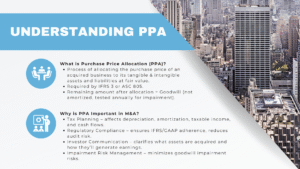
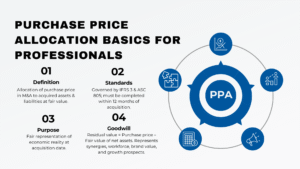
Purchase price allocations (PPA) are one of the most complex accounting exercises performed. Whenever a company buys another business, it needs to allocate the purchase price to the identifiable assets acquired and liabilities incurred, with the remaining difference allocated to goodwill. The accounting rules that govern PPA (primarily IFRS 3 and ASC 805) may seem very simple, but the implementation is fraught with judgment, data issues, and coordination problems that can trip up even seasoned practitioners.
For those starting out in M&A consultancy, transaction services, or corporate development, a knowledge of best practices for purchase price allocation in M&A is not a nice-to-know; it is a must-know. It is a professional necessity. Mistakes in PPA can result in material adjustments, regulatory inquiries, and a lack of trust with auditors, the board of directors, and shareholders. Much is at stake, and there is little room for error.
In this article, we review the challenges of a PPA engagement, the errors that are often made, and provide some insight into how to build a quality, defensible allocation. Even if you are working on your first PPA or have been working on your approach but have been stymied by auditors, the ideas in this article should be directly relevant.
Understanding Purchase Price Allocation (PPA) Scope and Intangible Asset Identification
The key to a successful PPA is to prepare before you begin. Too often, practitioners fail to appreciate the amount of preparation that needs to be done to identify all intangible assets, understand the rationale for the transaction, and collect the necessary data to measure the fair value. The purchase agreement, management presentations, customer contracts, IP registers, technology documents, and more are all crucial data sources and must be gathered early.
Perhaps the most critical early item is to reach an agreement with the client or the deal team about the deal’s rationale. Did the client buy the business for the customers, technology, brand, or employees? This will determine which intangible assets are likely to be significant, and what valuation methods will be most appropriate. If the purchase was motivated by a return on investment in software contracts, it is likely that a customer relationship intangible will need to be carefully valued, whereas if the deal is in consumer goods, trade names may be critical.
Teams that fail to run this diagnostic up-front can be caught off guard during the engagement with questions from the auditors as to why an asset wasn’t identified or why a particular valuation method is being used when the asset isn’t generating cash flows that way. Taking the time to scope the engagement is one of the key best practices for purchase price allocation (PPA) in mergers and acquisitions (M&A) that help to distinguish a quality job from a lacklustre one.
Table 1: Purchase Price Allocation (PPA) Intangible Assets and Valuation Methods by Industry
| Industry | Typical Intangible Assets | Common Valuation Method |
|---|---|---|
| Technology / SaaS | Innovative technology, customer lists, trade names | Relief-from-royalty, MPEEM |
| Consumer Goods | Trade names, customer lists, and non-compete agreements | Relief-from-royalty, MPEEM |
| Healthcare / Pharma | Research and development underway, patents, and customer contracts | MPEEM, Cost approach |
| Financial Services | Customer deposit base, core banking systems, licenses | MPEEM, Income approach |
| Manufacturing | Custom processes, backlog, vendors | Cost approach, MPEEM |
MPEEM = Multi-Period Excess Earnings Method
Five Best Practices for Purchase Price Allocation (PPA) in Mergers and Acquisitions
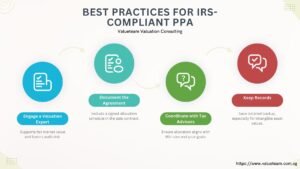
PPA is an exercise that relies on a process. Here are five key steps that should be incorporated into every assignment, no matter the size of the transaction.
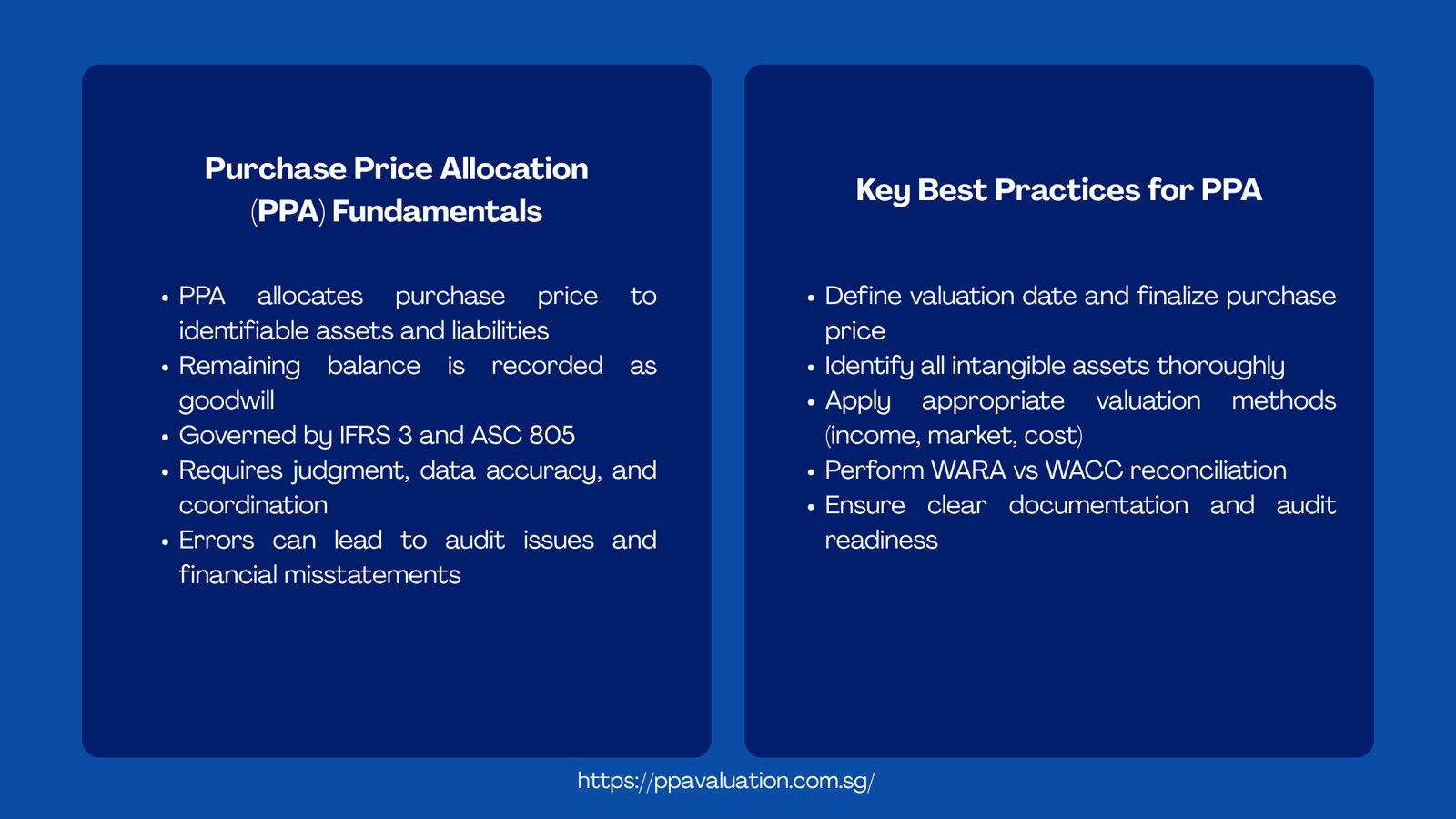
Step 1 – Select the valuation date and fix the purchase price. The valuation date is often the acquisition closing date, and the purchase price (including contingent consideration) needs to be calculated. Earn-outs and contingent consideration must be valued separately and are often a subject of dispute with auditors. Finalise the price calculation before developing an allocation model.
Step 2 – Very thorough asset identification exercise. In consultation with the transaction documents, interviews with management, and industry expertise, build a list of potential identifiable intangibles. Use the ascending criteria for classifying an asset: contractual-legal, separability. Failing to identify an intangible here will increase goodwill and attract scrutiny.
Step 3 – Rigorously choose and document methodologies. There needs to be a documented valuation of all identified intangible assets using a suitable method. The main methods (income, market, and cost) are applicable in different situations. Justification for the use of a particular method (and the rejection of other methods) is essential to support the audit process.
Step 4 – Conform to the WARA/WACC reconciliation. The Weighted Average Return on Assets (WARA) should be equal to the deal’s Weighted Average Cost of Capital (WACC). Any significant difference between the WARA and WACC flags that the returns on assets (including the contributory asset charges used in MPEEM) are not consistent. It is a best practice, and a question that auditors frequently ask.
Step 5 – Document, review, and anticipate auditor questions. The report should contain all assumptions, data sources, and calculations. Double review by a senior practitioner who was not involved in the initial analysis avoids errors being detected by the auditor. Anticipating and answering audit questions in the report is efficient and instills confidence.
Common Pitfalls in Fair Value Measurement in Purchase Price Allocation (PPA)
Despite having a process to determine fair value, there are common errors that can occur during the fair value assessment stage. Anticipating these pitfalls is helpful in avoiding them – and spotting them in others’ work.
Perhaps the most common is the use of management projections. In many transactions, the financial projections used in valuations are prepared to assist the transaction and may include optimistic assumptions about growth, profitability, or retention. PPA should consider the market participant perspective, not the company’s perspective. The fair value measurement of PPA items often involves the errors of taking management projections at face value and not comparing them with industry data, historical evidence, or market-based evidence from comparable transactions.
Another pitfall is not considering a customer attrition rate in the valuation of customer intangibles. The attrition rate is the key driver of the useful life and present value of the customer relationship intangible. Applying a low attrition rate (often because management is unwilling to accept a higher rate) can lead to an overvalued intangible asset and an undervalued goodwill. Both of these are undesirable: the first results in an overstatement of amortization expense; the second distorts the economic price paid for the target.
Another common mistake is related to the discount rate. Discount rates used to value individual intangible assets should be based on the nature of the cash flows, and not just the entity’s WACC. Customer relationships are more certain and short-term in nature, and should have lower discount rates than in-process R&D or contingent earn-outs. The use of a blended rate for all assets is an expedient that auditors and valuation specialists will question.
Table 2: Common Purchase Price Allocation (PPA) Pitfalls and Recommended Mitigation Strategies
| Pitfall | Root Cause | Recommended Mitigant |
|---|---|---|
| Using overly optimistic management forecasts | Too much deal team input | Benchmark vs. actuals and comps |
| Inappropriate attrition rate for customer intangibles | Lack of management support or data | Use industry data; justify assumptions |
| Discount rate not asset specific | Simplification for speed | Set rates by asset risk class; do a WARA test |
| Omission of identifiable intangibles | Incomplete scoping | Intangible identification workshop at the start of the project |
| Varying contributory asset charges (CAC | Mechanical errors in the MPEEM model | WARA check on CACs vs stand-alone values |
| Ignoring deferred revenue adjustments | Overlooked liability | Fair value all deferred revenues |
Real-World Purchase Price Allocation (PPA) Case Studies and Practical Lessons
Experience in engagements provides the best lessons. The following examples – based on patterns of practice rather than specific names – show how mistakes can be made and how to avoid them.
Case A – The Forgotten Distribution Agreement: In the acquisition of a mid-sized European consumer goods business, much attention was paid by the deal team to valuing the target company’s brand and customer relationships, which were significant. But a long-term exclusivity distribution contract with a large regional retailer (representing around 30% of revenue) was initially considered to be a contract that would be lumped into the customer relationship intangible. During the audit, the value specialist from the reviewing firm identified this as a separately identifiable contractual-legal intangible under IFRS 3. The engagement team had to revalue the asset, resulting in a value shift from goodwill to a new intangible with a different useful life and amortisation pattern. The takeaway: take a close look at the top revenue contracts individually and determine whether they are separately identified intangibles before grouping them into higher categories.
Case B – The Tech Company’s Discount Rate: A North American technology company acquisition had a complex developed-technology asset valued using the relief from royalty method. The practitioner used the entity WACC (12%) as the discount rate for the technology. The auditors noted that developed technology, such as software with a known market and low risk of obsolescence, is less risky than more speculative assets and, therefore, the discount rate for developed technology would be closer to the WACC than other assets, but the WARA reconciliation did not reconcile. The weighted average return (WARA) was different from the WACC for the deal. The solution was to update the discount rates for each of the asset classes in the allocation and rerun the WARA (and this took two weeks). This is one of the most common pitfalls in fair value measurement for PPA that should be easily avoided – the WARA-WACC reconciliation should be the last quality control step prior to reporting.
Case C – Deferred Revenue Overlooked in a SaaS Acquisition: In a software-as-a-service (SaaS) merger, the target firm had substantial deferred revenue on its balance sheet for prepaid annual subscriptions to services. Deferred revenue is fair-valued under purchase accounting – this usually results in a value that is lower than the remaining cost of fulfilling the deferred revenue plus a profit margin. The acquirer’s finance team initially continued with the book value of the deferred revenue liability, which led to an overstatement of revenue in the post-acquisition period after the revenue was recognised. The restatement, although immaterial for the group, alerted the external auditor and needed to be retrospectively restated. Adjusting for deferred revenue is often overlooked and is a prime example of how to avoid valuation errors in purchase price allocation – by making sure that all items on the balance sheet are considered for fair value adjustment, not just the “big ticket” items.
Managing Auditors and Stakeholders in Purchase Price Allocation (PPA) Engagements
A PPA is not a stand-alone project. It is a team effort that involves the deal team, management, external auditors, and perhaps regulators. Knowing how to work with these stakeholders is as crucial as technical know-how.
Auditors are very wary of reviews of PPA – not because they suspect nefarious activities, but because the judgments of the PPA have a material impact on the financial statements. The key to effective relationships between valuation practitioners and auditors is openness, documentation, and a commitment to solve technical issues. Making the report easy to digest by anticipating the questions that will be asked (rather than waiting for them to be asked) greatly reduces the timeframe of the review and the risk of “fire-fighting” at the end of the review period.
On the other hand, management stakeholders are quite often motivated to reduce the intangible asset base (to limit future amortization) or increase it (to reduce the goodwill balance to minimise the risk of impairment). Neither interest is per se improper, but practitioners need to be independent and work towards a fair value that reflects the assumptions of market participants, rather than the client’s views. This is one of the major professional challenges in the area of PPA, and avoiding valuation errors in purchase price allocation often comes down to being independent, even in the face of stakeholder challenges.
Transparency of methodology and early in the process also serves to avoid a surprise result that may be at variance with management or the deal team’s expectations. Providing an indicative range of possible intangible values (clearly identified as indicative) at the halfway point of the review cycle allows everyone to review the approach and data to ensure no issues are missed prior to final reporting. This should minimise the need for significant changes in the review process.
Table 3: Purchase Price Allocation (PPA) Stakeholder Map and Engagement Best Practices
| Stakeholder | Primary Interest | Engagement Tip |
|---|---|---|
| External Auditor | Defensibility of fair value estimates | Provide methodology memo early; document assumptions clearly |
| Management / CFO | Reduce amortisation cost; eliminate risk of goodwill impairment | Disclose trade-offs; key assumptions should be independent |
| Deal / M&A Team | Finish allocation to complete financial statements | Estimate time; report data gaps |
| Regulatory Authorities (if relevant) | Adhere to IFRS 3 / ASC 805 | No skirting around; comply with standards |
Best Practices for Accurate and Defensible Purchase Price Allocation (PPA)
PPA is an exercise that requires forethought, technical excellence, and communication. The issues raised in this article – whether it be a failure to identify intangibles, discount rate setting, or failure to make appropriate balance sheet adjustments – can all be avoided through proper process and approach.
For those wishing to develop their skill set in this discipline, here are some key lessons. First, don’t rush the scoping process. Identifying the rationale for the deal and all potentially significant intangibles before creating a model are the most important activities in a PPA project. Second, don’t take management forecasts at face value. Market participants’ expectations should be based on facts, not hopes. Third, use the WARA-WACC reconciliation as a sanity check of the valuation. Fourth, don’t neglect deferred revenue, contingent consideration, and other “hidden” fair value adjustments. Fifth, cultivate a good relationship with your auditor – it’s less painful to do it in advance.
The takeaway for practice is that best practices for purchase price allocation in M&A are more about process discipline, professional judgement, and understanding of the accounting standards and the underlying business of the acquisition than they are about formulas and calculations. The professionals who excel at this work are those who are interested in the business, objective in their analyses, and thorough in their documentations – attributes that no rubric can replace.
As the nature of M&A transactions changes, and the industries and countries in which they occur, the need for quality PPA work will increase. By learning the lessons in this article and putting them into practice, junior and mid-career professionals can earn the respect and technical capacity to do work that can withstand scrutiny – and that reflects the economic realities of the transactions they help to support.