Purchase Consideration Components in MA
Key Components of Purchase Consideration: Cash, Shares, and Contingent Payments
Learn Purchase Consideration Components in MA
In any merger or acquisition, the cost of the transaction is much bigger than a cash deal. The elements of the modern deal structure are frequently a combination of various elements of consideration – cash, equity, and contingent, each of which impacts the risk-sharing, reward-sharing, and control-sharing between the buyer and seller. The knowledge of these elements is essential to the person interested in planning or examining business combinations.
Under the guideline of IFRS 3 – Business Combinations, purchase consideration is the fair value of what the acquirer foregoes in order to obtain the control of the target company. This combination of different types of payments can greatly influence the accounting treatment, tax, and performance after the deal, and investor perception. A properly designed structure balances the interests of both parties, liquidity and risk, and meets the financial reporting standard requirements.
Cash Consideration: The Easiest and the Most Simple.
The simplest option of purchase consideration is the cash payment. They offer instant liquidity to the seller and can be measured at fair value readily because cash does not change in value.
Advantages of Cash Deals
- Certainty and simplicity: Both buyers and sellers can easily know the amount of value that is being traded.
- Speed: Cash transactions are also more likely to close more quickly as they do not involve the complications of issuing stock or valuation.
- Control: Cash acquisitions have the benefit of giving the target 100% ownership of the target at the time of the acquisition, which removes the post-deal integration uncertainty.
Considerations and Disadvantages.
Nevertheless, cash transactions demand a lot of liquidity or capital. Acquirers Multiple of these options can be employed by acquirers: cash can lead to lower working capital, leverage, or constrained future investment flexibility. Also, it may be risky to pay all in cash because in case the anticipated synergies or performance gains are not realized.
- Accounting wise, cash payment is valued at fair value during the date of acquisition and is included in total purchase consideration according to IFRS 3.
- Equity Consideration: Issue to Seller of Shares.
- In numerous acquisitions, some or all of the purchase price is paid in share of the acquiring company. This arrangement assists in maintaining cash and forces the interests of the buyer and seller to be in the success of the combined business.
Advantages of Share-Based Consideration.
- Preservation of cash: The acquirer will be able to make a deal with no heavy debt or cash outflow.
- Matchment of interests: The seller becomes a shareholder, which will benefit in terms of future growth and synergies.
- Tax benefits: Shares-based transactions would enable the seller to pay no capital gains taxes in various jurisdictions.
Accounting Implications
BIFRS 3 removes shares issued as consideration and valuing them as at the date of acquisition and not as at the date of announcement. When the share price of the acquirer varies between the time of signing and closing, then it can largely affect the calculation of the purchase price and goodwill.
This fair value is usually determined with the help of valuation specialists, in order to comply with reporting standards and be consistent with the financial disclosures.
Contingent Consideration: Paying on Future Performance.
Earn-outs are also referred to as contingent payments that are gaining popularity in M&A transactions. Part of the purchase price is attached to the future performance of the target company, be it financial or operationally, i.e., revenue growth, profit growth, or customer growth.
The structure enables buyers to control the risk besides encouraging the management team of the seller to remain active even after the acquisition has been made.
Contingent consideration types.
- Performance-based: Remuneration is based on attainment of certain financial goals.
- Market-based: The price is paid based on the stock market prices or the market standards.
- Time-related: The payment will be initiated after a specific set time, and it will usually be related to employee retention or integration.
Valuation and Reporting
According to the IFRS 3, the total purchase consideration should include the contingent consideration that is valued at fair value on the acquisition date. In case of classifying it as a liability, it should be measured at every reporting date with changes realised in profit or loss. When it is treated as equity it is not remeasured upon initial recognition, as explained in the Comprehensive Guide to IFRS 3 Purchase Price Allocation.
Probability-weighted scenarios and the use of discounting techniques are necessary to obtain an accurate estimate of fair value. Both the overly optimistic assumptions and the conservative estimates are dangerous because they may overinflate and underestimate, respectively, the potential benefits of the acquisition.
The role of Fair Value in the Measurement of Purchase Consideration.
IFRS 3 relies on fair value in its accounting of business combinations. It is defined as the price at which one would sell an asset or to the transfer of a liability between the participants in the market at the date of measurement.
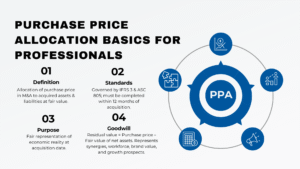
Purchase considerations should be valued on a consistent basis irrespective of the type of consideration given, be it cash, shares or contingent payments. The keyword that is highlighted below encompasses this principle: Step-by-Step Guide to Allocating Purchase Price under IFRS 3.
This approach ensures that the transaction reflects true economic value, aligning financial reporting with investor expectations and market standards.
Organizing the Right Blend: Risk and Reward.
The choice of the best mix of cash, shares and contingent consideration is based on the strategic purpose, market and economic flexibility.
- Deals involving plenty of cash are ensured when the interested party wishes to fully control the target and the value of the target is clearly known.
- The share-based structures prove best when the stock of the acquirer is high and the two parties want to be aligned in the long term.
- Contingent payments are more appropriate when there is uncertainty or high growth targets and they are used to bridge the valuation gaps.
An intelligent organization will help to cut down on the costs of financing, ensure liquidity, and help the integration process after the merger. The accounting, taxation, and valuation consequences of each of these elements, however, are that they will need the skills of a finance, legal, and tax advisor.
Tax and Regulatory Issues.
The purchase consideration composition has implications on both financial reporting as well as taxation and regulatory compliance.
- Cash transactions are normally taxated instantly to the seller.
- In certain jurisdictions, share exchanges can be considered as deferrable taxation.
- Contingent payment may give rise to deferred tax liability when recognised at fair value in advance.
Valuation assumptions made in regards to the share-based and contingent components are usually questioned by regulators and auditors to establish transparency and compliance. To ensure that disputes or restatements are avoided the proper documentation and disclosure is necessary.
The reason Professionals need to master the art of structuring purchase consideration.
Purchase consideration constitutes and has implications, which are necessary to know by the finance professionals and corporate strategists. Each of the elements, cash, equity, or contingent payments has varying implications on valuation and presentation of the balance sheet and profitability of the future.
Comprehensive learning programs such as purchase price allocation training for finance professionals help bridge the gap between valuation theory and practical application. These programs equip participants to analyse deal structures, assess fair value, and align accounting outcomes with strategic business goals.
The knowledge of these concepts would help professionals provide a tangible value throughout the negotiation process, due diligence, and integration after the acquisition.
Conclusion
Value, risk and control exchange in mergers and acquisition depends on the composition of purchase consideration. An organized combination of cash, shares and contingency payments balances the interest of both sides whilst adhering to the rules of IFRS 3.
Finance practitioners with the skills of purchase consideration may have a valuable input to the deal strategy, valuation, and financial reporting. As a global M&A activity becomes increasingly intricate, the capacity to organize and quantify these aspects is going to continue to serve as a foundation of successful corporate finance leadership.