Understanding Purchase Consideration
Understanding Purchase Consideration
Purchase consideration is the fair value of either that which the acquiring company imparts in place of control over another business. It encompasses cash as well as shares, debts instruments and future performance type of contingent payments.
The purchase will have to be valued at fair value on the date of acquisition, i.e. the date at which control is transferred and not the day on which the deal is entered into. This will guarantee that the financial statements indicate actual economic status at the time of the actual transaction.
The proper valuation and appropriate classification of these elements will determine how the acquisition will be recorded in the balance sheet and profit or loss, highlighting the importance of engaging Best Purchase Price Allocation Services in Singapore.
Establishing the Acquire and the Date of Acquisition.
The acquirer should be identified first before measuring anything. It is the body that takes the power of the running and decision-making of another firm. Majority ownership, voting rights or a contractual arrangement can result in control.
The date of acquisition is also significant – it is the day the acquirer actually has control. Any measurements such as purchase consideration and assets purchased are pegged on this particular date. The wrong identification of either one may result in material misstatements in financial reporting.
Elements of Purchase consideration.
The purchase consideration may be in various forms. The IFRS 3 expects that all of them should be fairly measured at the date of acquisition. These may include:
- Cash payments on a closing basis.
- Equity instruments, including the stock of the acquirer to the seller.
- Future payment based on being performed contingent.
- Apparently liabilities or liabilities of the target company.
- The previously existing equity interests, which should be reevaluated to a fair value in the event of a change of control.
All these elements represent the aggregate fair value of consideration transferred and should be identified in a transparent manner.
The Cash and Deferred Payments Measurement.
The easiest type of consideration is cash payments. The fair value is paid on the acquisition date. But when some of the payment is deferred, say to be paid a year or two later it should be discounted at a rate of interest that is shown in the market.
This guarantees that the total purchase price is the time value of money. Any financing structure, including seller loans or deferred settlements are acknowledged as independent financial liabilities.
Measuring Share-Based Consideration
When shares form part of the purchase consideration, their fair value is based on the market price of the acquirer’s shares at the acquisition date. For public companies, this is straightforward.
Fair value estimation is however more subjective when it comes to unlisted or private entities. similar company analysis, discounted cash flow (DCF) models, or precedent transaction multiples may be used by valuation professionals.
Share-based payments also have equity implications and may impact on the earnings per share in later periods and therefore their proper valuation is very essential.
Earn-Outs (Contingency consideration).
Contingent consideration Contingent consideration is sometimes referred to as earn-outs, and involves conditioning a portion of the payment upon future performance, e.g. a revenue target, EBITDA target, or net income target. This form is widespread when the purchaser is interested in controlling the risks or harmonizing their interests with the seller.
With the IFRS 3, contingent consideration can be determined at fair value at the date of acquisition, whether payment is likely to be made or not. This fair value estimation will entail outcomes of probability-weighting of expected results, and the discounting to the present value.
Contingent consideration will be re-measured at every reporting date and any adjustments will be recorded in the profit or loss, in case it is classified as a liability. When listed as equity, it will not be subject to adjustment once first recognized.
This renders the contingent consideration as one of the most judgmental fields of M&A accounting.
Inclusion of Assumed Liabilities and pre-existence Interests.
In other cases, the acquirer takes over the debts or obligations of the target. These are liabilities which are included in the aggregate purchase consideration in case they have value to the seller (i.e. the acquirer is to settle with them).
In case the buyer has already a vested interest in the target company prior to acquiring a 100 percent ownership, then IFRS 3 requires remeasurement of the interest to fair value of the target company as of the date of its acquisition. The difference between the profit or loss in this remeasurement is to be recognized immediately.
This will make the whole transaction a new acquisition and not a continuation of a previous investment.
The Purchase Consideration should be recorded.
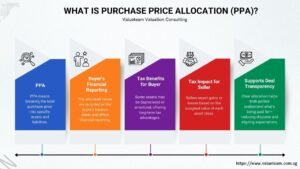
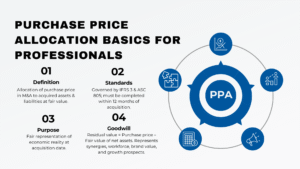
When everything has been calculated then the purchase consideration is assigned to identifiable assets that have been purchased and liabilities that have been taken at their fair values. The variance between the total consideration and the fair value of identifiable assets that are not part of the net is known as goodwill.
The following is a simplified structure of journal entries:
- Dr. Identifiable Assets (at fair value)
- Dr. Goodwill (balancing figure)
- Cr. Liabilities (at Fair Value) Assumed.
- Cr. Cash / Equity / Contingent Consideration (at fair value)
This entry has the benefit of keeping the two sides of the acquisition equation balanced and supported by the economic substance of the deal.
Disclosure Requirements under IFRS 3
Under IFRS 3, it is mandatory to disclose in finances statements of the acquirer the following:
- Fair value of the consideration transferred of purchase.
- The separation of cash, share and contingent elements.
- The fair value measurement methods and assumptions.
- Information regarding any contingent consideration arrangements.
- The causes of identifying goodwill or a purchase gain which was bargained.
Such disclosures enhance transparency and help investors to learn the impact of the transaction on financial performance.
Typical Practice-Based Iss.
In spite of the obvious standards, there are a number of difficulties when using IFRS 3 in the actual acquisitions:
- The importance of contingent consideration in the uncertain future performance.
- The fair value of unlisted equity instruments or intangible asset associated with the business.
- Hedging against the foreign currency risk, particularly on cross-border transactions.
- On reconciliation of accounting and tax reporting as local tax laws could not be identical to IFRS treatment.
Due to such complexities, several companies seek the services of valuation experts or auditors at the initial stages of the acquisition process in order to establish compliance and accuracy.
Significance to Finance Professionals.
Learning to measure and record the purchase consideration will empower the professionals in the field of finance to be able to handle mergers and acquisitions. It assists in financial integrity, the IFRS compliance, and informed decision-making.
Those who complete purchase price allocation training for finance professionals gain a practical grasp of valuation techniques, financial modeling, and accounting integration — skills that are increasingly valuable in today’s fast-moving corporate environment.
Their understanding of these principles enables accountants, analysts and CFOs to maneuver through intricate deal structures with ease and accuracy.
Conclusion: Understanding Purchase Consideration
Purchase consideration in business combinations cannot be adequately measured and reported without fair and transparent financial reporting. The components of cash, shares, contingent payments or assumed liabilities should be valued objectively to make the acquisition a true economic reality.
With the IFRS 3, fair value forms the basis of uniformity in business combinations. It is through the right and proper application of measurement and disclosure principles that the companies can create investor confidence, reduce post-acquisition wrangles, and remain internationally compliant.
To the accounting and financial practitioners, the learning of these concepts is not merely a technical compliance issue but rather the source of good corporate valuation and strategic development.