M&A Finance Integration Checklist
M&A Finance Integration Checklist
By the time you reach the end of an acquisition, it’s usually not the difficult part, it’s the implementation of the combined company that ends up killing most deals. A robust M&A Finance Integration Checklist provides a sequential series of dozens of tasks for Finance teams after a signed deal, from post merger financial systems integration to re-engineering the financial reporting workflows in the combined company. This article reviews and explains what should be on that checklist, how a transition plan in the context of a merger is typically carried out, and why financial controls after the acquisition and disciplined cash flow management during the merger are the keys to making it happen. It assumes that the reader will be a junior or middle-level finance professional that could be called upon to assist in, or take over, this work for the first time.
What Belongs on an M&A Finance Integration Checklist From Day One?
While an effective M&A Finance Integration Checklist begins well before closing, and many of the decisions which can be made during due diligence to set the stage for a smooth transition should be, rather than improvised in the heat of closing, are also included. This checklist usually divides tasks into the following workstreams: financial systems and data migration, accounting policy alignment, reporting and consolidation, treasury and cash management, and internal controls. In addition, the checklist is structured around these five workstreams, and not just one undifferentiated list, which means that various specialists in finance can take ownership over the sections that are most relevant to their expertise, and still report progress in a common checklist. It’s important that each workstream has a named owner and a set completion date based on the overall integration timeline, and a clear path for escalating decisions that can’t be made at the working level – one of the most common issues that derail tasks during the first 100 days after closing is ambiguity around who is responsible to complete the project. A checklist is no longer a one-off, static spreadsheet, most finance leaders now consider it a living document that is tracked via a shared project management tool; priorities change for integration as new information emerges, and a checklist that is not easily updated gets dropped after the first few weeks of a program.
A well-drafted checklist needs to reflect this distinction day-one and day-one-hundred priorities: it should not present every task as being equally important. Most often, on day one, it’s about running operations – ensuring that payroll is still executed, invoices are paid, basic financial reporting is still done – but that it’s done on a parallel system until the transition can be completed. The checklist gradually moves toward full integration as the various accounting policies are aligned, the many duplicate systems are decommissioned, and the integrated reporting packages are developed that management and the board will rely on to evaluate whether the transaction is performing as expected in the business case. When new members join the integration team, it is important to ask about the stage of the integration project, as that will influence what a reasonable day’s work looks like. For each item on the checklist, it’s useful to ask, for any item, what is really going to fail if it is late by one month – tasks with a real day-one dependency have a very different urgency level from tasks that are listed because they are going to eventually be executed somewhere in the integration timeline.
How Do Post Merger Financial Systems Get Consolidated?
The most complex technical aspect of any post merger financial system integration is often merging assets to a single ERP system, chart of accounts, and general ledger. The first choice is strategic: will the combined organization port the target company onto its own systems, or will it use the target’s systems if they are newer or better for the combined business, or will it choose a new system for both businesses, which is generally only applicable on a large scale in a transformational merger of similar size. While this generally means the target will be moved onto the acquirer’s system, most mid-market deals default to this approach because it maintains the same controls and reporting structure in place, but it should be tested against the capabilities of the target’s systems and should not be assumed. If the target’s systems really are better – for instance, if the platform being acquired is much newer or simply hasn’t been configured as well as the one the acquirer is using – it may be a chance some organizations see to modernize overall, but again, that comes with risks, in that it increases the complexity of the target’s system and can make the integration timeline even more challenging – and should only be considered if the organization is willing to take on the extra resources it will need.
The process of execution usually involves a phased process – that is, mapping the target company’s chart of accounts to the acquirer’s structure, then migrating historical data that is required for comparative reporting, and finally performing a ‘parallel close’ for at least one reporting period to ensure that the new structure results in the same outcomes as the old structure before it is decommissioned. It is good to have a defensible approach to the migration that will be a phased one as impatient stakeholders may wish to see a single-step migration of the financial systems, but the cost of a migration gone wrong, with restated figures and lost management time is almost invariably more costly than a few additional months spent taking the time to get the new configuration right. At this stage, data quality problems are all too common, as the acquired company may have years of inconsistencies built up over time that were not a problem for them individually, but show when two sets of data are matched. One of the more predictable methods to avoid a chaotic first time consolidated close in a post merger financial system is to actually allow for additional time for data cleansing, not to presume that it will be clean from one-to-one. Those teams that allow enough schedule buffer for this step, rather than working backwards from an earlier go-live date that they establish before anyone has looked closely at the data quality at the target, find that the migration goes more smoothly.
Table 1: M&A Finance Integration Checklist by Workstream – M&A Finance Integration Checklist
| Workstream | Key Task | Typical Timeline |
|---|---|---|
| Financial systems and data | Map chart of accounts and migrate historical data | Day 1 to Month 6 |
| Accounting policy alignment | Reconcile differing revenue and expense policies | Month 1 to Month 4 |
| Reporting and consolidation | Build unified management and statutory reports | Month 2 to Month 6 |
| Treasury and cash management | Consolidate banking and cash pooling structures | Day 1 to Month 3 |
| Internal controls | Test and document controls across the combined entity | Month 3 to Month 9 |
What Does the Acquisition Financial Reporting Process Involve?
The process for an acquisition financial reporting is from the initial entry on the purchase price allocation discussed in the previous posts in this series up to the management and statutory reporting which will continue for years to come into the combined entity. Developing this process with a second and third reporting cycle in mind – rather than just the first – will help teams avoid building a reporting process that addresses an immediate need and then creates rework after the initial urgency is gone. During the first period after closing, finance departments are likely to develop a standalone perspective of the acquired business, which would be beneficial to assessing whether the business is meeting the original deal thesis, and a fully consolidated perspective of the combined company’s results as per the accounting policies of the parent company. Being able to produce both views is one of the more technically challenging aspects of the acquisition financial reporting process in that it necessitates the team keeping two sets of adjustments—whereas it is quite possible to simply add the acquired company’s numbers onto the acquirer’s numbers without reconciling. A clean reconciliation of the two views will only be possible if adjustments are clearly mapped such as purchase accounting entries, intercompany eliminations, one-off transaction costs, etc. that might not have been part of an underlying performance view but have been included in the statutory results. Having this reconciliation as a regular monthly process will save a lot of time in the future once the framework has been set up and won’t result in different approaches from one reporting period to the next.
A well-managed financial reporting process for an acquisition would also be designed with the questions the auditor and audit committee would be likely to ask in the first financial reporting cycle in mind, which is usually the closest post-close reporting period. Auditors would like to know how opening balance sheet fair values have been calculated, how accounting policies have been integrated at the combined entity where the policies of the two entities differed, and whether internal controls at the acquired entity are in line with the accounting policies of the combined entity. Finance teams which develop an unambiguous audit trail during the actual process of making the decisions — rather than trying to piece it together months later — are much less likely to encounter unexpected surprises during this first cycle than those whose documentation is not as important as their accounting work itself. This type of documentation is also valuable after the initial audit cycle, as new finance team members coming on board months or years later can read through the document and learn the rationale behind the accounting treatment selected rather than relying on institutional memory, which tends to erode as people transfer to different roles.
What Five Steps Anchor a Reliable M&A Finance Integration Checklist?
- Name one person as the owner of each workstream. Close each integration workstream with one clearly accountable owner, as shared ownership without one is a frequent root cause of late integration projects.
- Distinguish between day one needs and longer term integration. Clearly separate out tasks needed for operational continuity on day one, and deeper harmonisation tasks that can reasonably be delayed for a few months.
- Build in time for data cleansing. Make an assumption that the target’s historical data will have to be reconciled before it can be easily mapped on to the acquirer’s systems and reporting structure.
- Run a parallel close BEFORE cutover. Test new systems and processes with a minimum of one full reporting cycle period, then fully decommission legacy systems.
- Record decisions made. Maintain an up-to-date accounting policy and systems history for future onboarding of new team members and first post close audit.
What Real-World Examples Show Merger Accounting Transition Planning in Action?
Thornbury Industrial Group, a diversified manufacturer, is the case in point, for it has recently purchased a smaller specialty components operation, about a third of its size. Thornbury’s approach is a well-done example of intentional transition planning, not reactive, and involves the finance team preparing their transition plan around a 12-month roadmap, so the acquired company’s legacy accounting system will be run concurrently for the first two quarters of the year with the systems team performing a chart of accounts migration in a sand box environment. This approach allowed the acquired business to continue closing on the old system and the integration work to go forward without the added pressure of having to rush a live cutover, while also providing the team with the benefit of knowing that the new system was delivering consistent results before the old system was phased out in month seven. One of the primary findings of Thornbury’s team after the move was that two systems running concurrently, although not ideal from an operational perspective, avoided a much bigger failed cutover that they and some other companies had seen in much shorter timeframes. Staff at the business acquired have also been given the opportunity to acclimatise themselves to the new systems over a period of time, as opposed to having to deal with one big switchover weekend, also having an impact on the number of support tickets raised in the weeks directly after the eventual switch.
Another example is Calder Health Systems, a healthcare services provider that acquired a regional competitor that had a very unique revenue recognition policy for long-term service contracts. Calder’s team chose to tackle accounting policy alignment as a specific early milestone—one of many in their larger M&A Finance Integration Checklist—and they were able to clear up the difference between revenue recognition because it was a factor in the reported revenue trends they were closely watching against the original deal thesis within the first 60 days. This early settlement also allowed the merged company to report its first full quarterly earnings without having to restate the numbers from the previous quarter to reconcile with the combined company’s numbers in the current quarter, thereby reducing the risk of the combined company’s numbers not being what they seem in the first few months following an acquisition. Calder’s CFO attributed the early emphasis on the transition planning for merger accounting to lending the integration team credibility with the board because getting the integration going well on a known and board-touched metric early put a case in place to ask for time and resources on workstreams that were less visible. The same thing is seen in other finance leaders who have successfully made the transition to accounting for mergers: when the team is successful with a visible transition, it receives more freedom with a different, less-visible transition.
What Challenges Come With Post Acquisition Finance Controls and Merger Cash Flow Management?
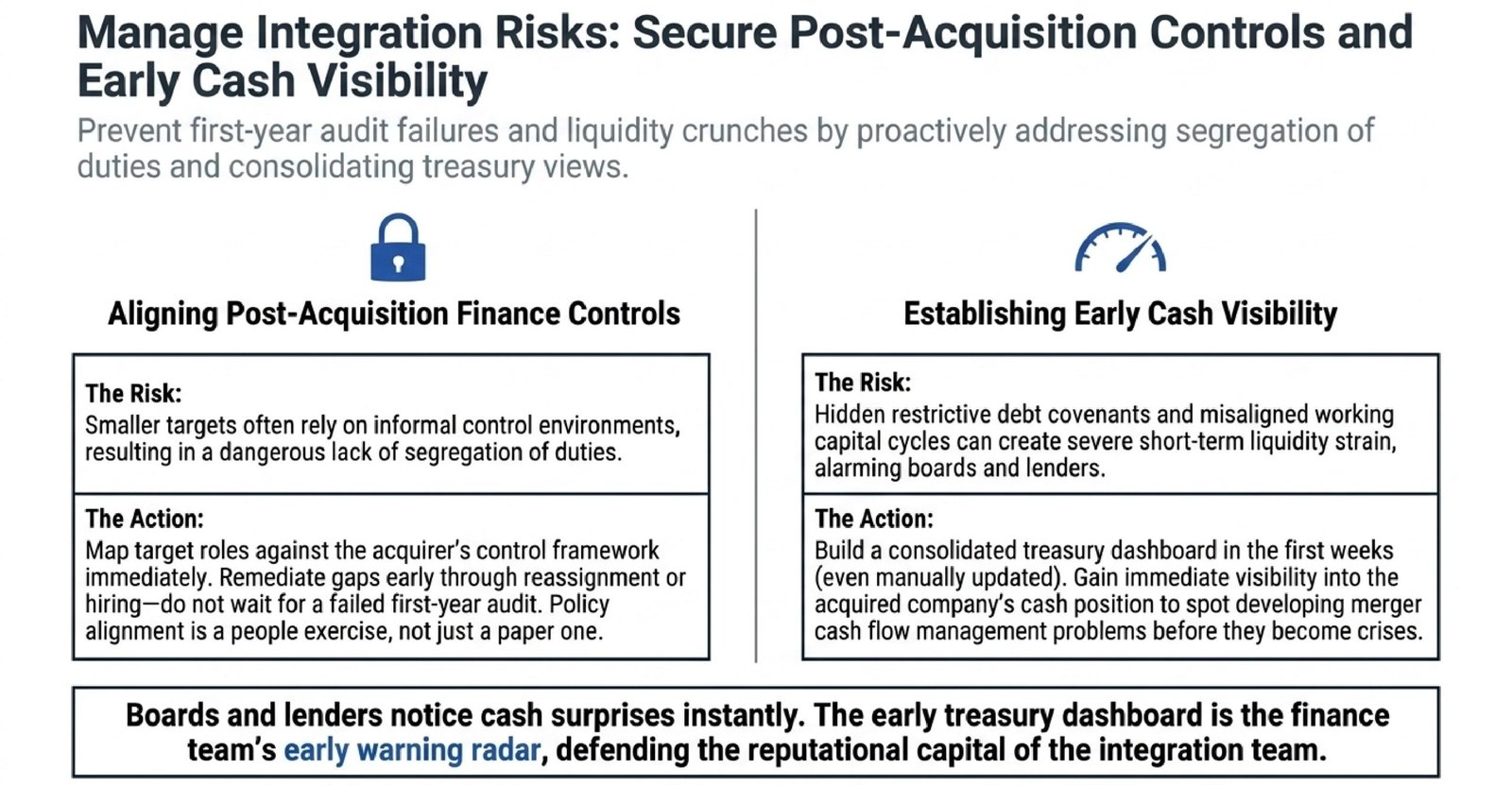
It’s actually hard to get the post acquisition finance controls together across a newly combined entity, as the acquired business typically has a different control environment, often more informal, or just depends on a smaller organization’s risk profile, and it takes time and training to get it to the acquirer’s level. In smaller acquired businesses, one individual may have historically performed multiple functions which the control framework of the acquirer prescribes to be accomplished by different roles and when designing the control framework, the separation of duties is a common gap that needs to be addressed, and often requires the hiring and/or reassignment of employees before the control framework can be effectively aligned rather than aligned on paper. The real challenge and key to a proper post acquisition finance control is not simply a documentation exercise, but one that relies on people and process. A control remediation plan is often a gap that is found during the initial year after an acquisition, and putting in place a plan to address them from the start of the integration process – not just when they are discovered at audit time – is likely to result in a smoother first year audit outcome. Not only is it beneficial for a smaller acquired business to have an honest control gap assessment done early, but a review conducted by someone who is not part of the day-to-day operations tends to be more thorough and will likely bring to light control gaps that those working in the acquired company have become accustomed to and no longer see.
Another related but challenging aspect of merger cash flow management is that two companies’ cash positions, banking arrangements and working capital cycles can be so intertwined that they create a short-term liquidity squeeze even if the paper entity is in good shape. Treasury teams require visibility into the cash position of the acquired company from the early days of integration, even if there are restrictive covenants on existing debt facilities that restrict the flow of cash from one entity to the other, as having unrestricted access to the acquired subsidiary’s cash can result in surprises at a time of liquidity crisis. While waiting for a more streamlined solution than a spreadsheet, it helps treasury if they can get a simple consolidated cash dashboard in the first weeks of a merger, instead of months or years later, so that they can see if a cash flow management problem is building up. The best practice integration teams have shared is that, like any other workstream in the integration process, the planning of treasury and controls work deserves to be structured, and not regarded as a side activity that will be “taken care of” once the other integration work has wrapped up. When a newly formed company suffers a cash shock in year one, boards and lenders will be alerted to it quite swiftly and the damage to the reputation of the finance team, for their capabilities of managing cash flows, may be more permanent than the shock itself. Thus, one of the more valuable and transferable skills that can be learnt by a finance professional through integration is the ability to build a genuine competency in cash flow management during the merger.
Table 5: Common Challenges in Post Acquisition Finance Controls and Practical Mitigations – M&A Finance Integration Checklist
| Challenge | Practical Mitigation |
|---|---|
| Inconsistent segregation of duties | Map roles against the target control framework and remediate gaps early |
| Limited visibility into acquired cash and covenants | Build a consolidated cash and covenant tracker from day one |
| Differing accounting policies across entities | Prioritize policy alignment on the metrics the board tracks closely |
| Legacy systems retired before validation | Run a full parallel close before decommissioning any system |
| Documentation gaps ahead of first audit | Log key decisions and rationale continuously throughout integration |
Conclusion: Making the M&A Finance Integration Checklist Work in Practice
While the negotiation preceding a deal is crucial to the financial success of that deal, so is the follow-up process of integration in the months afterwards, and a disciplined M&A Finance Integration Checklist is what it takes to make good intentions a repeatable well-sequenced program of work. The successful integration of post merger financial systems, the establishment of an adequate acquisition financial reporting process, ensuring comprehensive acquisition system accounting transition planning is completed, and proper financial reporting post acquisition system control and the careful management of cash flow result in the realization of the acquisition’s promised contribution to the combined entity’s financials. The next step for those gaining experience in this area is to examine a previous integration effort in which the integration checklist has been completed, and determine what work streams went well and what work streams did not, and use a comparison of the two to hone their vision for where additional attention is needed early on in the next integration effort before issues arise.