How Can PPA Improve Acquisition Reporting?
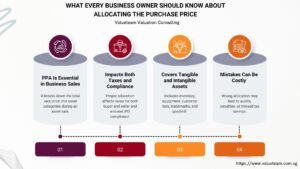
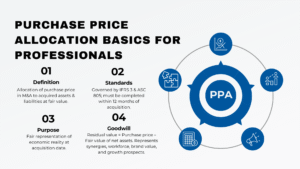
The financial statements of an entity result from the acquisition of another entity only if the accounting is appropriate and objective – that is, if it truly reflects what was acquired. The whole thing is about turning a well-negotiated deal price into a defensible set of recognised assets, liabilities and goodwill, and getting it right, and it can have a significant impact on what investors, lenders and auditors make of a company’s post-deal performance for years to come. Purchase price allocation is a topic that is relevant and applicable to a wide range of junior and mid-level accounting, valuation, and corporate finance professionals; it is one that may be presented during interviews, technical evaluations, and in deal work, and may be discussed well before a person is formally tasked with participating in a purchase price allocation. This article takes you through actual processes, typical challenges, and experiences, and explains what disciplined acquisition reporting improvements really mean in practice.
What Is PPA Acquisition Reporting and Why Does It Matter?
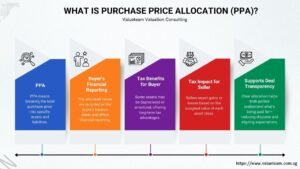
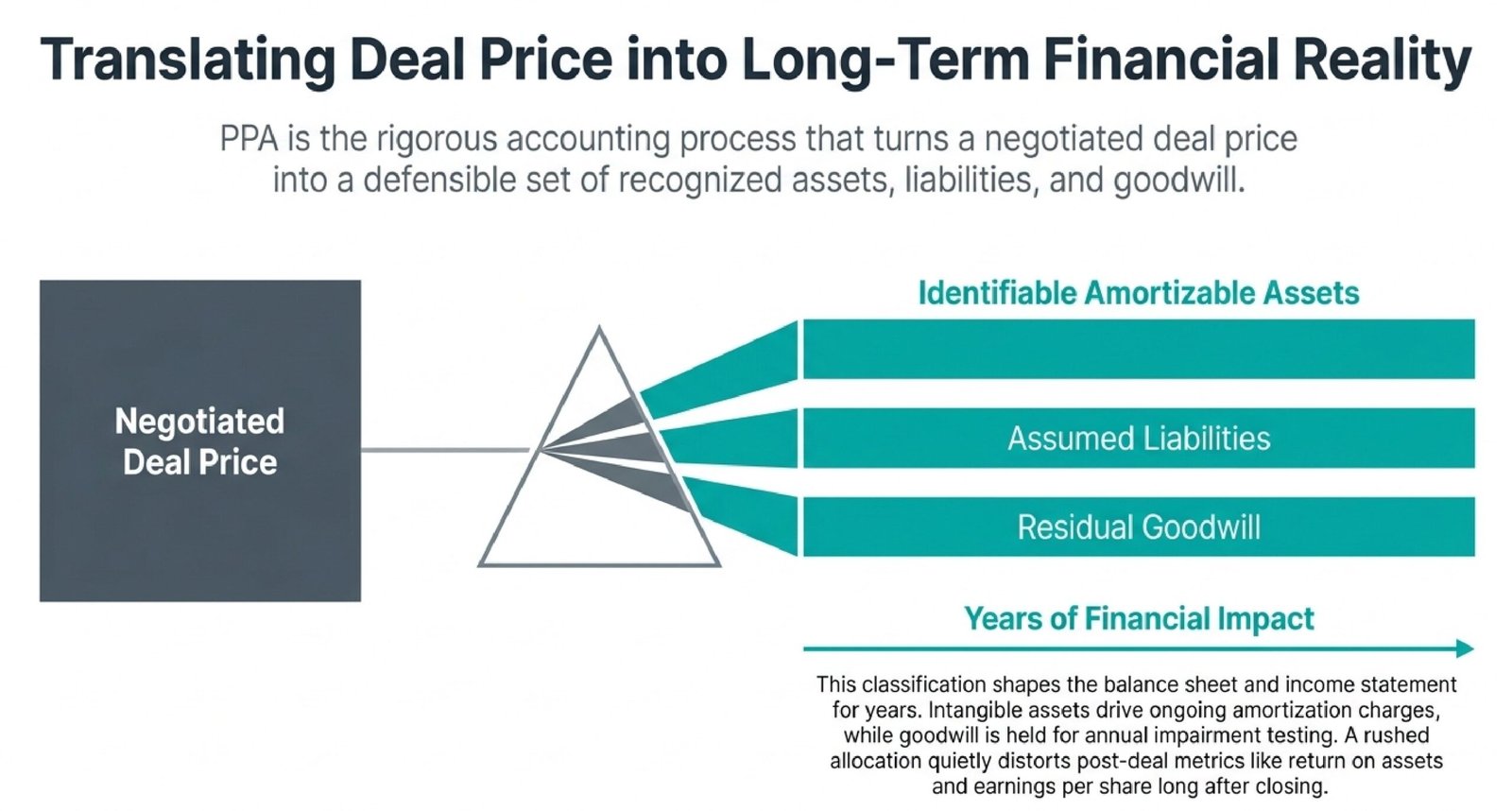
PPA acquisition reporting is the series of financial statement disclosures and the journal entries made to allocate the purchase price between the identifiable assets acquired and liabilities assumed in a business combination, and the excess amount recorded as goodwill. It is not just a mechanical once-off after a deal is closed; it affects the acquirer’s balance sheet and income statement for many years following the acquisition. The intangible assets identified in the allocation will be amortised over their useful life, while goodwill will be tested for impairment annually, not amortised. These two treatments differ quite dramatically, so that the initial classification made at the time of allocation has a permanent impact on the financial statements in all subsequent statements, not just the first after closing. An allocation that is rushed or superficial can then have a significant impact on earnings that is not immediately apparent when a reader of the financial statements is not aware of the deal details, such as return on assets and earnings per share. It can also make it more difficult for managers when assessing the performance of a business unit after the acquisition, as they would need to have a clear understanding of which charges are a part of normal business operations and which are the result of decisions made years prior to the acquisition.
That’s what makes it so important to the quality of reporting: the level of specificity the purchase price allocation brings, because a purchase price alone does not provide that specificity. The amount of the acquisition may be the same in two companies, but the benefit to the bottom line may be vastly different because one company may be more careful in identifying and measuring the underlying assets, which is why analysts who have had the experience of analysing two seemingly identical acquisitions may tend to look at the balance sheet composition instead of just the amount of the acquisition. Investors and analysts have paid more attention to these differences, as if a company has a history of overreporting goodwill compared to identifiable intangibles, then it could be a sign of poor acquisition judgment or the company’s reluctance to do the harder work in allocating the intangible assets. In the early weeks, months and years of a professional’s career, the first real trick is to see the link between the quality of allocation and the credibility of the reports produced by the deal team, and the most important thing to do is to understand why the deal team invests so much of its time in what appears to be just a technical accounting exercise. It is also a helpful window in understanding the acquisition history of a competitor: If a competitor’s recent acquisitions have seen a consistent trend of having higher goodwill balances compared to the disclosed intangibles of each transaction, then this may be a sign of a very good acquisition strategy or a sign of a not-so-strong allocation strategy.
How Does Purchase Price Allocation Strengthen Financial Statement Accuracy?
Purchase price allocation helps improve the information in the financial statements through the requirement to allocate identifiable assets, which are typically amortizable items, to a different category from the goodwill, which is the amount of value remaining after all identifiable assets have been fairly valued. The separation provides financial statement users with a better indication of what the company really bought because acquisition terms for a firm with a high valuation for its customer base and proprietary technology should be separated from the undifferentiated goodwill balance sheet item, which gives little indication of the underlying economics of the acquisition. If not, two acquisitions with very different business combinations, with very different rationales, can appear on the balance sheet virtually identical, and that is defeating the purpose of the business combination. With proper allocation, the amortisation and impairment charges are also more predictable and can be more easily modelled by analysts, thereby aiding in more accurate forecasts of future earnings. What is more important is this predictability when markets are volatile, when investors are going to closely examine whether the goodwill balance is a true reflection of the underlying economic value of the company or if it was merely reported from an earlier and less sophisticated goodwill allocation.
The table below highlights the distinction between how acquisition reporting is likely to differ if the company has done a thorough purchase price allocation process versus treating the exercise as a formality that is quickly done in the weeks following closing. It’s a good exercise for the younger professionals looking to interview for transaction advisory or corporate accounting, as it defines the real-world implications of the technicalities of that subject. It’s a common question that interviewers often ask candidates in this space – they want to see how the candidate thinks through the process, not just the numbers.
Table 1: Acquisition Reporting Improvements From Strong Purchase Price Allocation
| Reporting Area | Without Rigorous PPA | With Strong Purchase Price Allocation |
|---|---|---|
| Goodwill balance | Inflated, poorly supported | Reflects true residual value |
| Intangible assets | Understated or unrecognized | Separately identified and measured |
| Post-deal earnings | Distorted amortisation patterns | Predictable, well-supported charges |
| Audit and disclosure risk | High, frequent restatement risk | Lower, well-documented rationale |
The impact of a rigorous allocation is not only cosmetic; it can affect goodwill balances, how the goodwill is amortised, and the audit risk for years following the transaction. (See table.) That’s why savvy deal pros don’t view the allocation as a routine compliance exercise to be completed as quickly as possible after signing — and why many finance teams now make allocation review a regular part of their post-close checklist, rather than leaving it up to the team member who has the free time in the weeks after a transaction.
What Are Five Key Steps to Deliver Acquisition Reporting Improvements?
If a professional wants to enhance the acquisition reporting improvements process in their organisation, they can do so by following a logical sequence instead of trying to develop a whole new process from the ground up for each acquisition. The five steps below are typical of the process that an experienced valuation and accounting team would follow to take a rough estimate and arrive at a complete, defensible, and audit-ready allocation.
First, bring valuation and accounting (VA) experts into due diligence, and not after purchase, so that assumptions made in the period of due diligence are based on actual operating data, versus back-calculating the purchase price. Second, create a comprehensive list of assets to identify, which is specific to the target’s industry; so, an asset list meant for a technology acquisition versus a manufacturing acquisition will reveal different types of identifiable intangible assets, and a generic list used in every deal will likely overlook the assets most specific to the target’s industry. Third, make sure you record the reasons for all important decisions, such as basic discount rates, estimates of useful life, or the choice of a specific valuation technique, because a judgment, if left unrecorded, is always first in the line of fire for auditors and regulators. Fourth, compare the allocation to the original investment thesis presented to the board or investment committee because if it doesn’t match up, then it’s a red flag that should be examined before the file is finalised. Fifth, re-evaluate the allocation before the measurement date of the acquisition, which is usually no later than 12 months after the acquisition date, taking into account information concerning facts and circumstances that existed on the acquisition date but were not known at the time of the initial draft. One of the most common issues that arise when the allocation subsequently requires extensive rework is that specialists were not engaged in the process, and the assumptions made are more likely to be questioned when the auditors or regulators start asking detailed questions.
What Real-World Examples Show About PPA Acquisition Reporting?
Suppose a medium-sized industrial equipment company buys a small business as a means of obtaining a trade secret manufacturing process and an existing customer base. This type of acquisition is prevalent in the industrial arena, and the real value of a company may not be in its physical assets but in years of process knowledge that is not on a traditional balance sheet. The valuation team made an initial proposal to allocate a significant portion of the purchase price to goodwill, largely based on the fact that the trade secrets were not easily valued and not much of a comparable market transaction had been observed, as the valuation process is not something the team has seen licensed to others. A more detailed examination, in response to some questions from the external auditor, showed that a defensible value may be placed on the proprietary process using a cost-based approach and the cost of an independent development of a similar capability, which moved a material level of value away from goodwill and towards an amortizable intangible asset, thereby materially impacting the company’s forecasted post-deal earnings trajectory. The finance team pointed out that this was a frustrating change as it added to time-sucking just before the reporting deadline, but overall, the amended file was much more defensible when the acquisition was looked at again during a subsequent unrelated audit in two years.
A second example is a consumer products company that bought a smaller, more regionally focused brand, mainly for its trademark and distribution networks. It was reasonable at the time, as the initial deal team was in a hurry to complete the initial reporting cycle, to use industry benchmarks to determine the length of the trademark’s useful life. Later, when the finance team looked at customer retention data revealing decades of steady brand loyalty, the useful life was adjusted upward during the measurement period, thus influencing future amortisation charges and better representing the brand’s actual competitive longevity. The updated numbers also proved to be valuable beyond the scope of the accounting lines since the marketing team used the same customer loyalty data when making its case to continue investing in the acquired brand versus incorporating it into the parent brand’s existing product line. In both cases, the key takeaway is that the initial allocation is typically not the most precise, and it is important to revisit assumptions against actual operating data, which are often what makes a defensible acquisition report vs. one that will come under fire later.
What Are the Benefits and Challenges of Acquisition Reporting Improvements?
Improved acquisition reporting, when done well, provides significant benefits to companies and the financial statement preparers. Investors and lenders acquire a clearer picture of what was really acquired, a situation that facilitates informed decision-making on capital allocation and can reduce the cost of audit or regulatory examination, especially if the company is planning for future capital raising or a secondary listing where old acquisition accounting will be more closely scrutinised. Internally, the strict allocation also provides the management with a better basis to determine whether the completed acquisition has produced the value they expected. As intangible assets have been identified separately, it is easier to measure the acquisition’s performance against the reasons for its original pursuit. This type of post-acquisition monitoring is becoming more and more the norm on boards, especially following a series of big deals that have fallen short of their promised synergies, and a proper allocation provides management with a much firmer basis for ongoing post-acquisition monitoring. In the context of a career focused on a deal, one of the more visible activities that can reflect technical credibility early on is a contribution to an effective allocated work product, given that this work product will be reviewed closely by the audit team, senior finance team members and perhaps even external regulators.
The obstacles are tangible, though. Preparing a sale price allocation is often done with restricted post-closing time frames and with the integration teams working hard to merge the operations together. Preparations of a sale price allocation are often done under tight post-closing time frames while the integration teams work diligently to merge the operations together, allowing little time for the detailed diligence required for a defensible allocation. In addition, reliable information may be limited, especially when valuing private enterprises with private targets that are not public cpost-closingd that have less detailed financial and operational history, meaning valuation teams are forced to rely more on management representations, which sometimes turn out to be overly optimistic. This is particularly so if the company is a founder-led business being sold for the first time, where the books might not have been kept to provide detailed operational analysis – which a rigorous allocation needs. In recent years, auditors have become even more demanding regarding documentation, even if the other components of the deal document are technically sound, in case the rationale for an allocation is not solid or in line with other components. Buy-side transactions come with additional complexities as well—such as accounting standards, currency, and local market data—and they can impact the level of confidence that a valuation team can place in its findings. Another common real-world challenge in PPA acquisition reporting is reconciling the time and data pressures with the need for accuracy, and this ability is one that can only be honed with repeated exposure to actual transactions – through the study of them alone, it cannot. Young professionals joining this field tend to think that a lot of what they do isn’t the technical valuation calculation but the negotiating and convincing process within the company—making an argument for the deal sponsor that they need to spend a bit more time on the valuation calculation to get a better allocation.
Conclusion
The quality and credibility of financial statements are enhanced in the context of PPA acquisition reporting conditions where the purchase price allocation is based on verified data, where the assumptions and calculations are clearly documented, and where assumptions are reconsidered prior to the end of the measurement period. The practical lesson for the professionals who use these tools to develop their careers in accounting, valuation or corporate finance is that it is important to view each one as an opportunity to showrigourr, rather than a formality to be executed as expeditiously as possible after a deal signs. A key way to establish early career technical credibility in M&A work is to strive to improve the process of acquiring reporting; key strategies include early involvement of specialists, documenting the process, and making assumptions based on evidence. Those professionals consistently creating defensible, well-supported allocations will gain the trust of the more complex transactions as they move up the corporate ladder, as deal volume increases across industries. The principles are the same whether you’re analyzing the first assignment you’ve ever worked on, or preparing a valuation engagement as a senior manager that you will have to defend long after you’ve put it together: Check your assumptions with real evidence, be clear in your documentation, and assume that every allocation you made is one you’ll have to explain much more in-depth than you might think.