What Makes a PPA Valuation Audit-Ready?
A purchase price allocation may sound like a well-rounded write-up on paper, but then an auditor begins asking some probing questions about an individual assumption, and suddenly it falls apart. One of the most practical things a junior valuation analyst or finance professional can learn to answer is: What Makes a PPA valuation audit-ready? A technically sound valuation that is not defensible upon review, is, in a very real sense, incomplete work. This isn’t as easy as getting the numbers right, it is about structured documentation, clear thinking, and an understanding of what is trained for an auditor. This article discusses the extent of the documentation and process considerations that are important for making a valuation audit-ready; what a typical valuation audit valuation review focuses on; how audit valuation requirements affect the everyday work of the analysts; and what lessons have been learned from valuations that have passed review easily and those that have not.
What Makes a PPA Valuation Audit-Ready From the Very Start?
The level of sophistication of the model isn’t what makes a PPA Valuation audit-ready, it’s the quality of the documentation supporting all of the inputs that go into that model. If the formula in the discounted cash flow model for an acquired customer relationship intangible is correct but the rationale for the growth rate, the discount rate, and the useful life is not obvious, the auditor reviewing the DCF will ask a number of questions: Why was a particular growth rate selected? Where did the discount rate come from? How was the useful life estimated? The valuation team will have difficulty getting the figure signed off if they cannot answer these questions clearly, even if the underlying model is mathematically sound. The best way to distinguish between a smooth audit process and the stressful one is to build this documentation habit from the first day of a valuation engagement, instead of having to piece it together months later when the request comes for a review. The practice can seem surprisingly quick and easy when the analysts do it early in the process because it is still fresh in their minds during that time, rather than weeks later, when they have to recall it. This is sometimes referred to as the difference between making a decision, and recalling reasons for making a decision, under pressure of time.
The second “core” element is the consistency of the assumptions, i.e., the assumption in one part of the valuation should not silently contradict the assumption in another. A frequent problem that auditors find is a discount rate that is used for one intangible asset that does not have a logical relation with the discount rate for a similar intangible asset in the same allocation, or a growth assumption that is used in the cash flow model that is different from the growth assumption disclosed elsewhere in the investor materials of the deal. An IT company that had undertaken a post-acquisition deal faced this very issue, the customer relationship intangible being priced at five per cent long term growth rate while the developed technology intangible was priced at ten per cent. This type of catch is where a PPA valuation audit can help reveal the hidden truths, and is why the internal review before the external audit is so beneficial. When a figure is presented to someone external, a habit of internal cross-checking will pick up most of these errors early, before they become a documented error.
How Does Audit-Ready Valuation Guidance Shape a PPA Valuation Audit-Ready Process?
Whether created within the finance function or sourced from a recognized valuation standards body, the audit-ready valuation guidance provides an analyst with a framework that details the type of documentation and reasoning an auditor will look for, and not leave each analyst with an impression of what is enough. The information in good audit ready valuation guidance should include documentation of the sources of the data, presentation of sensitivity analysis on key assumptions and the reconciliation of the individually valued assets with the total purchase price that a reviewer not familiar with the deal needs to follow to verify the work without the need for verbal walkthrough. Teams that develop this sort of guidance internally, and tweak it after every engagement, are likely to see their valuations become more consistent and more defensible over time, than teams that begin each engagement with a blank template and ‘build it in the field’. Companies that build this type of institutional valuation audit-ready guidance early will benefit from multiple transactions, as each completed transaction will provide another transaction to audit the guidance against. Smaller finance teams, who don’t have the resources to develop this guidance from scratch, may be able to use published guidance from professional valuation bodies, taking the general principles and adapting them to their industry and deal type.
In addition to audit-ready valuation guidance, it also alters the everyday functioning of a valuation team from a reporting focus to a focus on documenting a reasoning process that culminated in a conclusion. A letter of just a discount rate of 12% will be far less valuable to the auditor and much riskier to the company than a letter that derives the 12% from a risk-free rate, an equity risk premium, and an asset-specific risk adjustment, each of which is sourced and backed up. If you develop this habit early in your career, you will create a lot less work to go through the review process, which is a big deal when you have a filing deadline looming and not a lot of room for back and forth with the reviewers. This habit also alters the way analysts think about the reasoning process itself, as they must account for themselves as the process is documented before anyone else attempts to do so. Many experienced valuators will say this self-scrutiny is the best secret of good documentation practice, as most of the time it is only when the documentation of an assumption is put on paper that the weaknesses become apparent, rather than by a question on the assumption from a reviewer.
Table 1: Core Elements of Audit-Ready Valuation Guidance
| Element | What It Covers | Why Auditors Check It |
|---|---|---|
| Source documentation | Where each data input originated | Confirms figures are not fabricated or estimated casually |
| Assumption reasoning | Why a specific rate or growth figure was chosen | Tests whether judgment was applied consistently |
| Sensitivity analysis | How the result changes under different assumptions | Shows the valuation is not overly fragile to one input |
| Reconciliation | How individual asset values sum to the purchase price | Confirms the allocation is internally consistent |
| Prior period comparison | How current assumptions compare to past valuations | Flags unexplained shifts in methodology or judgment |
What Does a PPA Valuation Audit Actually Look For?
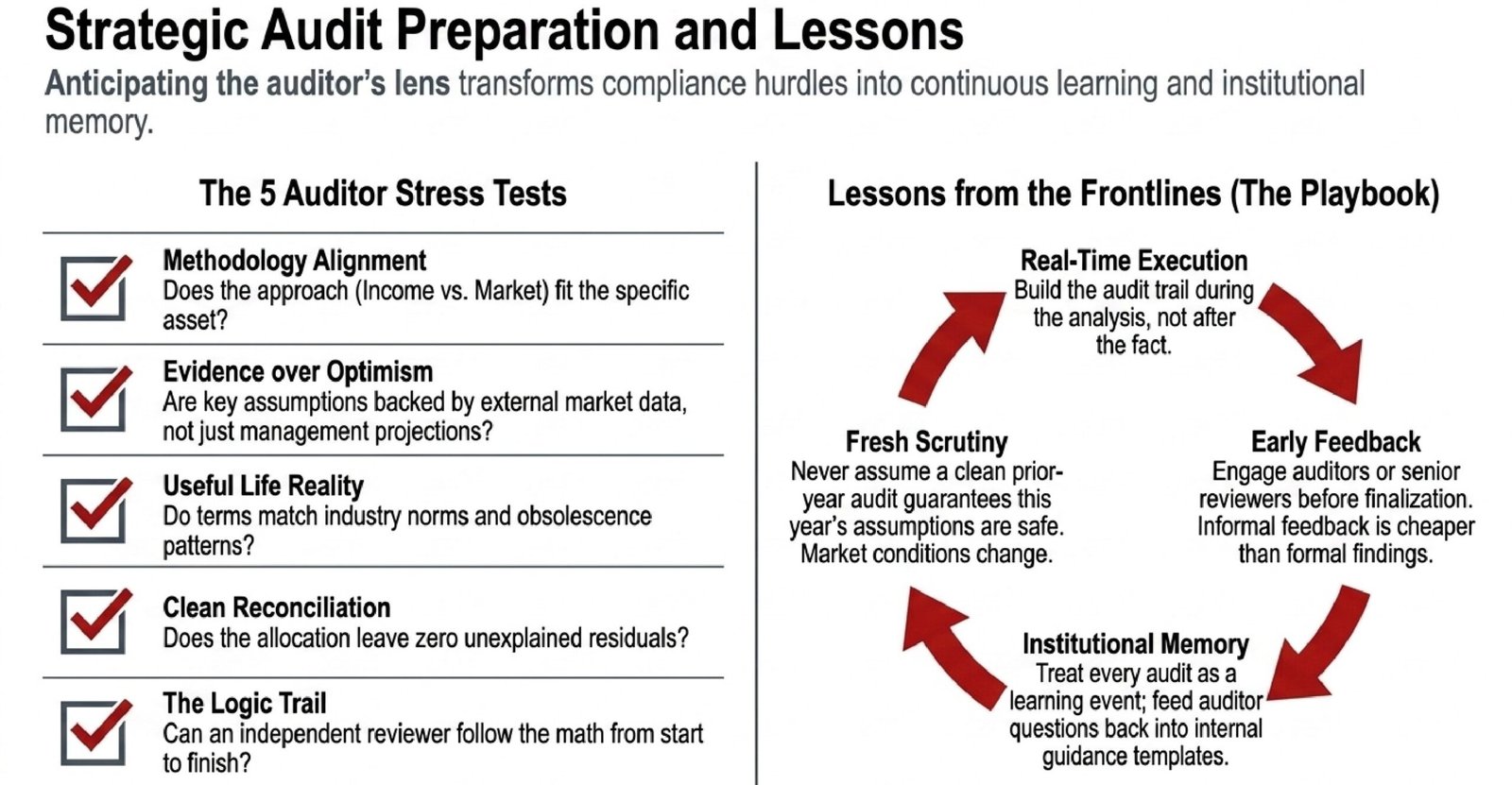
The most common themes that are explored in a PPA valuation audit are a few. And, anticipation of these themes is probably the most effective method of preparing for a valuation before it is formally reviewed and audited. Although there are a variety of questions asked from engagement to engagement, the following five points are what most auditors are testing when performing an audit of a PPA. Firstly, the valuation technique matches the nature of the asset as an income appraach to an asset that is more suited to a market approach is a common red flag. Second, if the key assumptions are based on external evidence and not solely on the management’s cheerleading projections. Third, if the useful life assigned to each intangible asset is reasonable, based on industry standards, contract terms or technology obsolescence. Fourth, if the allocation reconciling without any unallocated purchase prices.Fourth, if the allocation is such that no purchase price is left unallocated. Fifth, the documentation is complete to the extent that a new reviewer, not involved with the original engagement, could follow the logic from the beginning to the end. If teams anticipate the use of these five focus areas before beginning a valuation, or if they build this work product from the ground up, instead of adopting them reactively during a PPA valuation audit, then their work product is going to be much stronger from the outset of the valuation. It can be a simple measure to include a new analyst in the group, but if it is done at the start of onboarding instead of allowing them to learn by doing, they will get a head start in the learning curve.
A good example is a consumer products company that had acquired a smaller competitor in a specific region and then was subject to a detailed PPA valuation audit as part of its external audit review, as part of their annual review. The auditors placed a large emphasis on the valuation of the trademark, raising the question: why was the royalty rate used taken from license agreements in another industry, and not from data that was more relevant to consumer packaged goods? The valuation team could respond promptly because they had already prepared a comprehensive document describing several alternative royalty rates that they considered, and explaining the reasons for the selection of the final rate, so that they were able to reach a decision the same day instead of a protracted negotiation. This type of situation is a good example of why it is better to expect a PPA valuation review during the initial engagement, than to have it as a separate review later in the process. It also illustrates a general rule that should be taken to heart: questions an auditor poses are not random, and they are likely to be directed to those areas where judgment had the most impact, and where documentation is most crucial. It helps a valuation team to focus their documentation where it’s needed; it doesn’t stretch the documentation out thin over every component of the valuation if that component really didn’t need any documentation.
How Do Audit Valuation Requirements Affect What Makes a PPA Valuation Audit-Ready?
The minimum expectations for a PPA valuation audit-ready are defined by the audit valuation requirements, which are based on accounting standard requirements and professional standards that auditors are expected to adhere to. Requirements usually require that fair value measurements be based as far as practicable on rates or prices observed in the market, and that any use of unobservable inputs be adequately explained and disclosed as regulators and standard setters are growing more vigilant and prescriptive regarding the quality and transparency of fair value estimates in financial statements. Having a valuation team with an awareness of these audit valuation requirements in advance of the model, and not when the questions come up in response to a pushback by a reviewer, will create a structure that is more likely to meet the requirements that are likely to be asked during the audit. This proactive attitude also tends to reduce the total engagement time required as significantly less time is spent re-doing parts of the analysis that were not originally designed around a future review. Companies that consider these as a design constraint up front rather than a compliance box to tick at the end do the entire valuation process more efficiently, in terms of time and effort expended.
Having a valuation process that starts with audit valuation requirements is a significant advantage because it greatly simplifies the review process and reduces the likelihood of needing to rework the process at the end, thereby potentially delaying a filing or causing friction with an audit committee. The problem is that such requirements may be too abstract to be understood by a junior analyst whose attention is geared toward just making the model generate a reasonable number, and that’s a process that will take deliberate coaching and repetition. Teams that get a junior analyst to review an audit valuation for a real engagement early in a reviewer’s career, with the goal of walking through the audit valuation application and requirements, will develop this instinct much more quickly than teams that allow the reviewers to learn it through trial and error themselves. This is one of the more overlooked investments that a finance function can make in itself, as the benefit is realized again and again in each and every engagement that the analyst has in the future.
What Lessons Help Keep a PPA Valuation Audit-Ready?
In numerous engagements completed, you will find that certain lessons resurface enough to be considered a standard practice for anyone attempting to learn the answer to the question of What Makes a PPA valuation audit-ready. First, document during analysis, not afterwards – weeks or months later, it will be much more difficult and less accurate to reconstruct the reasoning behind a decision. Second, engage an audit team, or a valuation reviewer who is used to the audit process, prior to finalizing a valuation in order to receive feedback before a formal audit finding is made after a deadline has elapsed that is much less expensive than the cost of a formal audit finding. Third, the internal template should be consistent across engagements, as the faster and lower the number of procedural questions an auditor can ask, the more quickly the engagement will be completed. Fourth, use each audit as a learning opportunity, documenting all the questions that arose and applying these lessons to the team’s audit-ready valuation guidance to make sure the same question doesn’t appear again on the next deal. Fifth, don’t assume that the findings of a clean audit of the prior year are conclusive, or that the assumption was correct this year, because market conditions and company circumstances are subject to change from year to year, and the well-supported assumption of yesterday could be this year’s weak spot.
The one thing that’s clear, however, is that having a PPA valuation audit ready doesn’t happen as if it were a last minute submission – it’s an attitude that should be maintained throughout the valuation process from the initial data request to sign-off. People who do documentation and audit valuation requirements as an afterthought always spend more time and are more stressed out when they have to respond to review comments than those who make it a habit. This attitude change, from reading about being ready to auditors to just doing good valuation work – often gets analysts into a higher level of valuation roles than the ones that are still lured back into doing their work again, hastily. It’s a way of thinking that’s not something that will have to be relearned, unless a professional just forgets about it; it will simply be a way of approaching any analytical task, and valuation in particular.
Conclusion: Key Takeaways on What Makes a PPA Valuation Audit-Ready
What Makes a PPA Valuation audit-ready is not a daunting compliance nightmare—it’s a learnable practice that can be done early in the process and reap benefits later when an audit happens—and it’s one that you can do. The next step for anyone pursuing a career in valuation or accounting is learning about a working valuation guidance framework, practicing the process of providing a complete explanation of the steps involved in a sample discount rate or growth assumption, and becoming comfortable with the types of questions a PPA valuation audit will ask before they are asked. One of the quickest ways to internalise these habits is to read through the disclosure examples of how the audit valuation requirements are applied in practice, and see how well well-prepared companies have documented their audit assumptions. This approach allows maintaining a valuation audit-ready to be an integral part of doing careful and credible work, not an additional hurdle to clear at the end. One of the fastest ways to develop real and sustainable audit readiness into a job is to review a past engagement as though a skeptical auditor is watching it for the first time, and make a list of the sections in which the reasoning is not fully provided, addressing them in every future engagement.