What Intangible Assets Are Identified in a PPA?
However, there can be no straightforward correspondence between the acquisition price paid and the assets on the balance sheet of the target company, and determining the location of the other was one of the more technical, but very interesting aspects of post-deal accounting. When a deal closes, one of the first questions finance teams and auditors ask is, what are the Intangible Assets identified in a PPA? The answer to this question will impact years of future amortization, tax treatment, financial statement accuracy and much more. Knowing what PPA intangible assets are will come up frequently for those who are entering the field of accounting, valuation or corporate finance and want to understand how to build a model from the ground up or review a filing. In this article we look at the definition of intangible assets, the reality of how these assets are actually valued, an overview of the PPA valuation process and what the lessons are for practitioners from real transactions.
What Intangible Assets Are Identified in a PPA During the Diligence Process?
Prior to the formal accounting effort, deal teams begin to develop an understanding of the intangible assets being identified under a PPA from what is really generating the target’s earnings. A software firm’s worth could be nearly all in its code and contracts with clients whereas a consumer brand’s worth could be in its trademarks and customer loyalty accrued over years and years. This early “diligence” work is important because it impacts the range of assets that will go into the eventual “valuation” engagement; the valuing team that assumes goodwill will typically end up absorbing most of the purchase price, and often not notice the assets that a more careful “look” would have identified and valued separately. Typically, an initial list of potential PPA intangible assets is developed during diligence, and this list is narrowed down after closing of the transaction and post closing documents are created. Analysts typically consider customer relationships, technology, trade names, non-compete agreements, and order backlogs as potential intangible assets. This preliminary list is rarely unaltered during the formal valuation process, but provides the deal team with a realistic idea of how much of the purchase price will be allocated to goodwill and sets expectations for future amortization that will limit the unpleasant surprise when the final numbers are presented to the board. It is also important for the finance team to build this preliminary view early as it will enable it to scope the valuation engagement more effectively, and budget the appropriate time and specialist resources before the clock begins to tick on the engagement.
This early identification needs input from other than the finance team. Legal staff can identify the contracts that can be assigned and thus have value as separate intangible assets, engineering can explain the difference between proprietary and licensed technology and sales can explain which customer relationships are locked into a contract versus being based on loyalty and informal promises that may be lost under a new ownership. In one situation, a manufacturing business made the assumption that the primary value driver of the acquisition of a smaller supplier would be the equipment, and then during the process of diligence, they found a small number of long-term supply contracts, which were clearly distinguishable intangible assets, that were the real driver of the economic value of the transaction. The case is an example of the importance of not omitting to specify what intangible assets are, before closing, as this will save a lot of rework during the formal accounting process. It also helps the team who is negotiating the deal understand what they’re paying for, as the purchase price that would largely be based on contracts (not assets) would be more of a risk if the contracts were not renewed after the sale. This sort of early knowledge can even formulate the structure of the deal, as the buyer might choose to negotiate particular retention contracts and/or contract assignment protections, rather than finding out the risk after the deal is closed.
How Does IFRS 3 Shape What Intangible Assets Are Identified in a PPA?
According to the accounting standard for business combinations, IFRS 3, an identifiable intangible asset is measured separately from goodwill when either a contractual-legal criterion or a separability criterion is met. This includes any intangible asset that may be contractual or legal rights, for example a licence, patent or customer contract, or anything that can in theory be sold, transferred or licensed separately from the business as a whole, although the company may not be planning to do so, and what it considers to have a value in use. In practice the distinction would be of great significance, since it is much wider than the list of intangible assets which most companies would have identified on their own balance sheet before the acquisition. For example, a list of customers may not have been recognized as an asset under the target’s accounting policies before a transaction, but after the transaction it will often be required to be recognized separately, valued and amortized. One of the more paradoxical facts for newbies to purchase accounting is that a non-existent asset can suddenly become one of the biggest line items on the acquirer’s balance sheet.
The categories of intangible assets recognised in a PPA are very similar under ASC 805 and apply to the majority of the categories recognised under IFRS 3, although there are some variations in the measurement guidance. A number of categories of intangible assets are recognized under the IFRS 3 intangible assets rules such as “customer relationships”, “trademark and trade name”, “developed technology”, “non-compete agreements” and “favourable lease arrangements” for which different methods of valuation and useful life estimates are applied. Less experienced parties often make the mistake of using this list as an exhaustive and generic list, when in fact, every transaction is unique and the specific assets that gained value from the business transaction will need to be assessed on a facts and circumstances basis, and it may be possible to argue that the intangible value created by the business transaction is more than what it actually is. Valuation of IFRS 3 intangible assets practitioners’ work is frequently quoted to be the hardest part of the job is not the actual maths of the valuation, but rather determining whether or not the asset in question actually qualifies for recognition in the first place. That’s just because the more you see the standard in various contexts, the better you will be able to judge.
Table 1: Common PPA Intangible Assets Recognized Under IFRS 3
| Intangible Asset Category | Example | Typical Valuation Method |
|---|---|---|
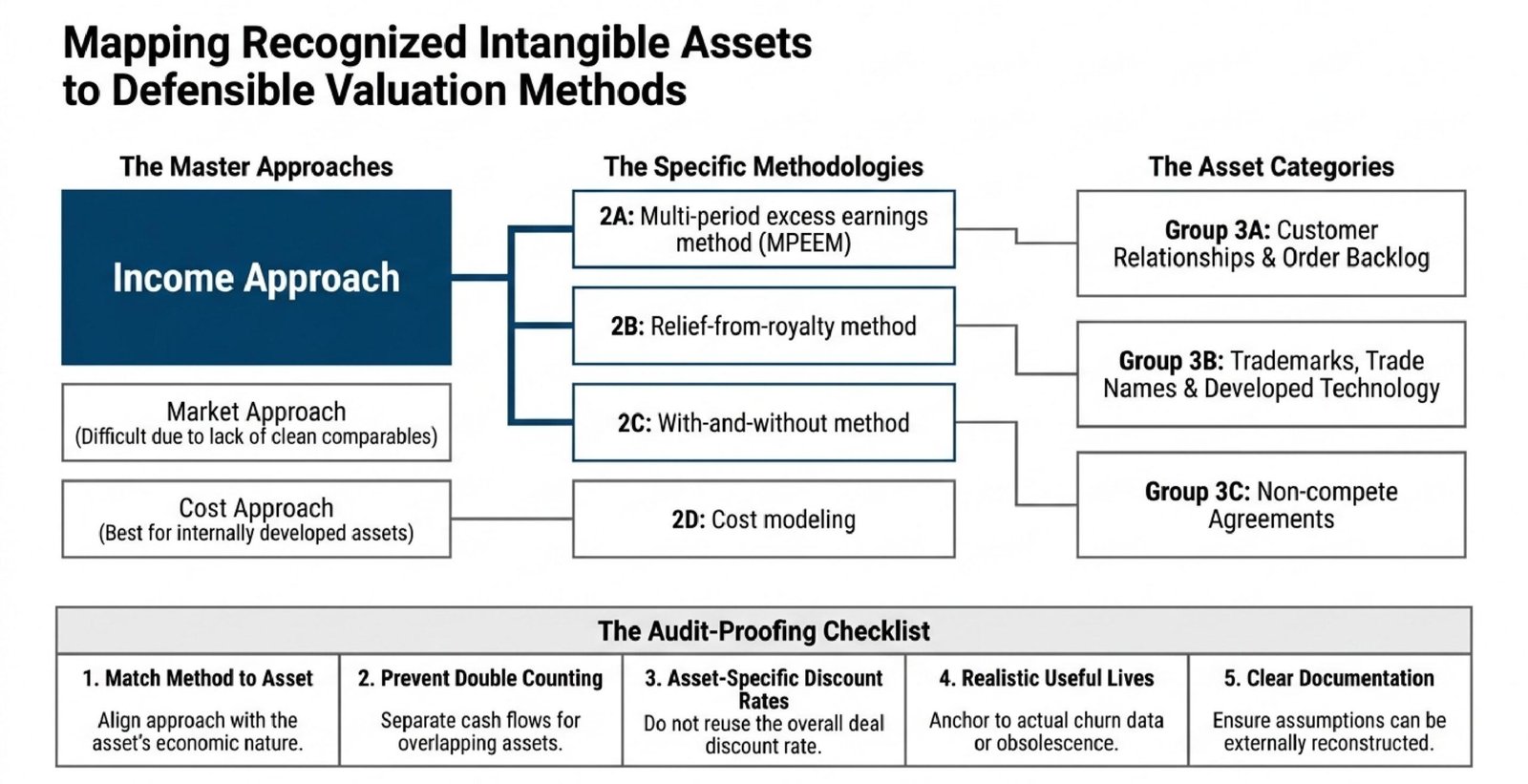
| Customer relationships | Long-term contracts, recurring accounts | Multi-period excess earnings method |
| Trademarks and trade names | Brand names, logos | Relief-from-royalty method |
| Developed technology | Software, patented processes | Relief-from-royalty or cost method |
| Non-compete agreements | Restrictive covenants with sellers | With-and-without method |
| Order backlog | Signed but unfulfilled customer orders | Multi-period excess earnings method |
What Intangible Assets Are Identified in a PPA Through Intangible Asset Valuation Methods?
After the identification of the categories of PPA intangible assets, the more difficult part of the task starts—defensibly assigning a fair value to each of the intangible assets that will withstand the scrutiny of an auditor. The general methods used for valuing intangible assets are three in number, and determining which is applicable to a particular asset is as crucial as the math used. The income approach is the approach that is most commonly used and is based on the future cash flows that the asset is expected to generate, usually using the multi-period excess earnings method or the relief-from-royalty method. The market approach involves comparing this asset to similar assets that have been recently sold, purchased or licensed. However, for something that is truly unique, there are likely not to be many comparables available. The less commonly applied cost approach involves estimating the cost of developing the asset anew, and is best suited to software or processes that are developed internally, and in which there is little or no meaningful licensing market. The selection of one of these three approaches is also an intangible asset valuation judgment, and is one of the areas where the expert’s skill will distinguish him from the checklist taker, because it may be possible to value the same type of asset reasonably in more than one way, and the final choice depends on which of the approaches the available data will support. Junior analysts may think the math is the most challenging aspect of this work, but seasoned reviewers will likely agree that it’s harder to determine from the available evidence what method the evidence would support than to develop a complex model around a method the evidence could not justify.
The five points below are the key focus areas of most valuation teams for intangible asset valuation work in a PPA context and each one covers an error that typically crops up when auditing intangible asset valuation work in a PPA context. First, the valuation method needs to be matched to the asset; for example, it wouldn’t make much sense to use a relief from royalty approach for a customer relationship where there is no comparable licensing market. Second, not double counting — assets can be the same (such as Customer Relationships and Workforce Value) if care is not taken to separate the cash flow projections. Third, applying a specific discount rate for each intangible asset as opposed to recycling the overall deal discount rate for all intangible assets. Fourth, using the churn data, contract requirements or technology obsolescence to arrive at a realistic useful life instead of a round number such as ten years. Fifth, clearly documenting all the assumptions in such a way that another analyst (or an outside auditor) would be able to conclude the same result a year later.
What Does the PPA Valuation Process Actually Look Like Step by Step?
The initial steps in a typical PPA valuation process start well before closing takes place, as the valuation team reviews materials of due diligence and management projections and the purchase agreement to gain insight into the deal structure and likely intangible assets. Upon closing transaction, the team performs detailed financial information, customer contracts, technology documentation and management interviews to update asset list and create supporting cash flow models. This process can become very complicated, as with an acquisition of a biotechnology company, where all value is dependent on a single in-process research program and the valuation team must create a probability-weighted model based on the chances of the research program making it from one stage to the next before receiving regulatory approval for a product. The example illustrates the need to recognize that a generic PPA valuation process template often does not work across industries, because the assumptions underlying the value in a technology PPA are quite different from the assumptions underlying the value in a life sciences PPA, even if the categories of PPA intangible assets seem similar on paper. Especially for teams that are new to such work, it is easy to think that a background in general finance is enough to provide a credible valuation, but in reality, an understanding of the pathway to the regulatory path or the curve of technology adoption in a particular industry can make all the difference.
The last few steps in the PPA valuation process include the reconciliation of all the individual valuations to the purchase price and ensuring the goodwill amount is reasonable in light of the strategic justification for the transaction, as well as ensuring documentation is detailed enough to withstand audit. Disagreements arise from the deal team’s initial assumptions and what the detailed valuation actually shows is one of the most common problems to come up in a reconciliation, and it is much easier to sort it out before the numbers are finalized than to have to describe a last-minute change to the audit committee several months after the numbers are first reported. Companies that take the time to perform this reconciliation rather than rushing through it as a formality before filing deadline are able to create a better and more defensible allocation every time. Many seasoned practitioners will argue that an effective PPA valuation process is not so much the quality of any one model, but the extent to which each individual model can be reconciled to a coherent and internally consistent narrative explaining the source of the value in the deal. It’s there, at the end of the reconciliation, that some of the most valuable lessons for the next transaction emerge, as the team works through the “what went well” and “what took longer than expected” items in a clear manner.
What Lessons Improve How Intangible Assets Are Identified in a PPA?
Many transactions have been closed and a few lessons do keep recurring and are worthy of being considered as standard practice. First, having the valuation team involved early, before closing a PPA if possible, allows them to properly scope what intangible assets are being identified in a PPA, as well as giving the team time to get the analysis done before the reporting deadline. Second, when legal, tech, and sales departments contribute to a cross-functional list, it is more accurate, as opposed to a purely finance team list based on documents. Third, the useful life assumptions should be as closely examined as the valuation figures, because an overly long useful life could understate amortization expense and mislead the reader of the earnings for several years after closing the deal. Finally, teams who have historical data of their valuations for the entire transactions, are more likely to develop a body of knowledge about the organization that will make the next PPA valuation process more expedient and repeatable, rather than starting over again each time a new acquisition is completed. Fifth, don’t let the audit team be a problem or a bystander, and leave them in on the important assumption discussions before the analysis is done; this can result in a smoother review than if a completed valuation is presented without any changes to it.
But the most important takeaway is that the PPA valuation process is best applied when it’s done in a truly collaborative fashion, not a compliance process delegated to one analyst on a hard deadline. There is a need for auditors, tax advisers and the valuation team to converge on the assumptions prior to finalisation as there may be situations where there is a lack of convergence that may cause a filing to be delayed, and lead to an awkward discussion in the audit committee. Faster moving professionals are those who know how intangible asset valuation relates to the rest of the accounting and tax implications of a transaction, not those who have been taught to create the spreadsheet but get nowhere because they don’t know why each number is important. This expanded knowledge also is very useful when speaking to non-technical board members, and that is as important as the technical work of the valuation itself when a board member asks, “Why is goodwill larger or smaller than expected?”. Those who can answer that question without getting into jargon are the ones that get called back for the next deal, not the ones who are a one-time resource.
Conclusion: Key Takeaways on What Intangible Assets Are Identified in a PPA
The concept of intangible assets identified in a PPA is no longer an accounting specialty, but rather a practical competency that has implications for deal structuring, financial reporting, and years of post-acquisition analysis. For professionals embarking on a career in this area, the next best step is to understand how IFRS 3 intangible assets are applied in practice, to adapt the valuation techniques to the type of intangible asset, and to get accustomed to the work in reconcilating the individual asset values to the overall purchase price. One of the quickest ways to develop real fluency in the PPA valuation process is to look at a few actual PPA disclosures in public company financial statements and follow through and see how a company’s PPA disclosure of intangible asset valuation relates to the amortization expense that is disclosed. When done in this way, the identification of PPA intangible assets is no longer a daunting, technical task that can only be done by the experts, but a learnable exercise. Do this exercise a few times, reverse-engineer the amortization schedule from the public filing, and go back to the underlying intangible asset valuation model and ask the valuation team what they had to assume about the value to get to that amortization schedule; how many times you have to do this exercise before it becomes more intuitive than any textbook chapter. This sort of real-world experience evolves to true professional sense, the kind that allows a junior file to see an odd assumption in a filing before a senior will.