What Are the Key PPA Steps in an M&A Deal?
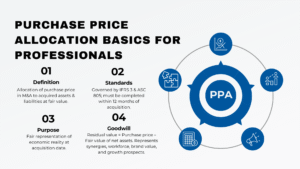
A key PPA step in an M&A deal is one of the most important pieces of knowledge to have when you are in the corporate finance, accounting or deal advisory space, and it is becoming a recurring topic in job interviews for analysts and associates. But the work is far from over as soon as the merger or acquisition closes; the acquirer must decide how the purchase price will be allocated to the acquired company’s assets and liabilities in accordance with a formal purchase price allocation process. Purchase price allocation, not just as defined in the books, but in practice, is a skill that is transferable to careers in audit, valuation, and corporate development, and is often one of the first technical skills that a junior analyst is expected to master on a live M&A transaction. This article reviews the key steps, the most common choices of purchase price allocation methods, and the lessons that have been learned in actual engagements, so that you can be confident in your understanding of the subject for interview and on the job.
What Are the Key PPA Steps in an M&A Deal Before the Work Even Begins?
The first thing the deal team should confirm before any valuation activity is undertaken is the acquisition date and the total consideration transferred, which will be used as the basis for all calculations thereafter. It’s not always just a cut-and-dried amount of money – it can involve issuing stock to previous shareholders, contingent earn-out payments based on future performance, and resolving any existing relationships between the two companies. This initial figure is the basis for all the subsequent steps of the purchase price allocation process; hence, it can affect every aspect of the process, and skilled practitioners spend more time on this step than novices are likely to imagine. One area that is often confusing for a junior analyst is contingent consideration, which has to be fairly valued at the acquisition date and not just the highest possible amount.
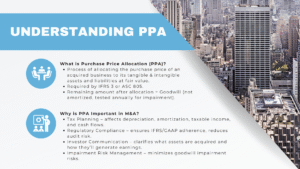
There is also a need to determine the accounting framework to be used, given that most international entities as well as the Australian entities apply the AASB 3 or IFRS 3 accounting framework, while US-based filers will apply ASC 805. While these standards are in general harmony, there are some differences in terms of contingent consideration and treatment of transaction costs. Whether in the context of an asset sale or a sale of shares, the first step in the M&A purchase price allocation analysis is to determine the standard that applies (and why), which will influence all subsequent decisions, and it is wise to verify early rather than assuming that the rules are the same in all jurisdictions. The foreign acquisition further complicates the issue here, as the two businesses may have previously had different accounting systems and structures, and need to be carefully reconciled before the allocation process can even get underway.
What Are the Key PPA Steps in an M&A Deal When Identifying Assets and Liabilities?
The next step in the purchase price allocation process is to establish a list of all assets and liabilities acquired, which may include assets and liabilities that were not on the target company’s balance sheet. This may include intangible assets like customer relationships, brand names, proprietary technology, and non-compete agreements, which have not been recognized under the financial statements of the target company in the past because they have been created by the target rather than acquired by the acquirer. Finding these less tangible aspects of the business depends on a close working relationship between the deal team, valuation experts, and the operational leaders who know how the business creates value. One of the most helpful practices at this stage is to start from a standard list of the intangible items that are typically not listed by the target, such as: key proprietary processes, long-term supplier contracts, etc.
Many of the challenges in M&A purchase price allocation come to light at this stage. Contracts might not be fully formed, customer information may vary from one system to another, and vital employee members of staff who have a firm grasp of some of the intangible assets may have departed following the announcement of the transaction. One of the most important things that junior analysts often discover is that it pays to involve them in the process early, while due diligence is ongoing, rather than waiting until after close, as this gives the team more time to collect clean data and minimises the risk of a hasty, unsupported valuation. It is helpful to create an asset inventory during due diligence (even before the clock is ticking on the measurement period) and helps save weeks of rework when the clock starts counting.
What Are the Key PPA Steps in an M&A Deal When Selecting a Purchase Price Allocation Method?
Selecting the appropriate purchase price allocation method for every identified asset is one of the most technically challenging aspects; there are different types of assets and different approaches to value. Tangible assets include property, plant and equipment, and are usually valued on a cost or market basis, optionally adjusted for condition or remaining useful life. Intangible assets are generally estimated by income methods, for example, relief from royalty for trademarks or multi-period excess earnings for customer relations. The table below provides a summary of the most frequent methods for each asset class.
Table1: Purchase Price Allocation Method
| Purchase Price Allocation Method | Typically Used For | Key Consideration |
|---|---|---|
| Cost approach | Property, plant, and equipment | Reflects replacement cost adjusted for depreciation |
| Market approach | Assets with observable comparable transactions | Requires sufficiently active and comparable markets |
| Relief-from-royalty method | Trademarks and brand names | Relies on defensible royalty rate benchmarks |
| Multi-period excess earnings method | Customer relationships and core technology | Sensitive to attrition rate and discount rate assumptions |
The choice of purchase price allocation method is as much a matter of judgement as technical modelling skills, with the wrong allocation leading to material errors in the value of certain assets even though the overall allocation seems sensible. Practitioners tend to cross-check the results where possible – for instance, an income-based intangible valuation with any data available from the market, for similar assets, where available; a large unexplained difference between the two methods is often a good indication that one of the underlying assumptions should be reconsidered before the result is finalized.
What Are the Key PPA Steps in an M&A Deal for Goodwill and Residual Value?
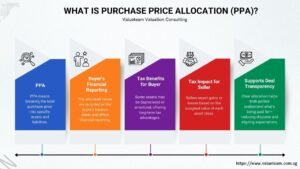
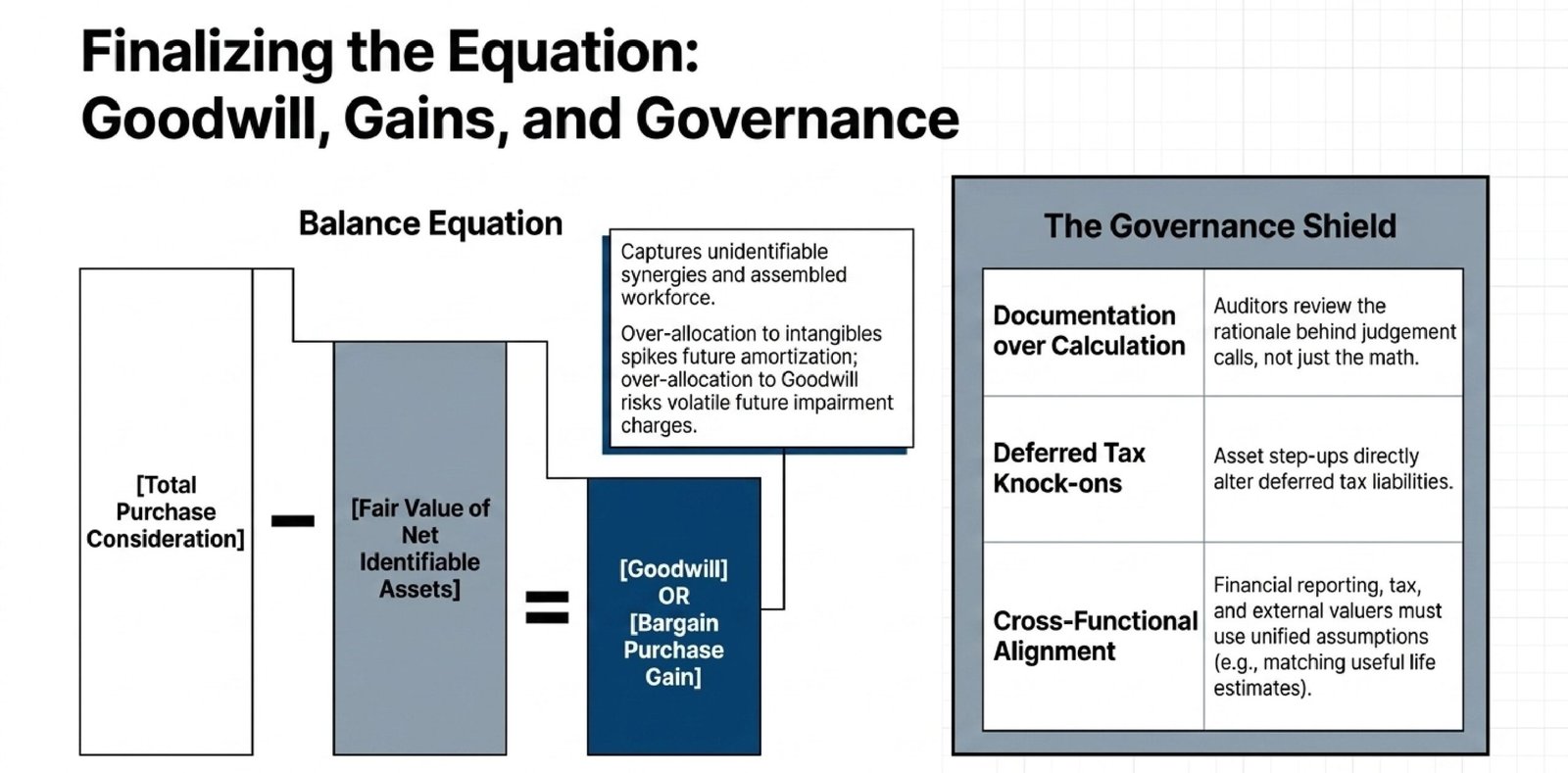
Once all identifiable assets and liabilities have been valued, the amount by which the purchase consideration exceeds the fair value of net identifiable assets is considered goodwill. Goodwill is the value of an asset that is not shown as a separate identifiable intangible asset and is attributable to an asset of the business that is not separately identifiable but has been acquired through a past transaction. In rare situations where a consideration paid is below the fair value of the net assets acquired, there is a bargain purchase gain that will need the acquirer to be careful about the assumptions made before recognising the gain, as unusually large bargain purchase gains are subject to heightened scrutiny by regulators and auditors.
A key point in the purchase price allocation process that is often the point of contention between finance and the auditor is the value of goodwill and intangible assets. Over- or under-valuation of goodwill and under- or over-valuation of identifiable intangibles can lead to unnecessary earnings volatility in the future and to an under- or over-estimation of the amortisation expense, respectively. When a professional completes their first few purchase price allocation exercises, they often find it difficult to explain the reasons behind each of the judgement calls that go into documenting the allocation, rather than just the final allocation. It’s also important to remember that it is not amortised under most existing standards, with goodwill being tested for impairment instead, and so an overstated goodwill balance can cause the finance team the headache for many years after the deal has closed.
Five Key Steps in the Purchase Price Allocation Process
While there may be more than five steps involved in a purchase price allocation engagement, the following five steps are the most important for most finance and valuation teams to follow when completing a PPA engagement, and in practice, they are typically done in this order on a live deal.
- Verify the consideration transferred and the date of acquisition, including consideration transferred subject to a contingency or consideration deferred and the contingent or deferred consideration shall be fairly valued as part of the acquisition consideration.
- Recognize all identifiable acquired assets and liabilities, including intangible assets which may not have been on the target’s own balance sheet.
- Identify and apply an appropriate method of purchase price allocation for each asset category, consistent with the valuation approach of the asset.
- Determine goodwill or bargain purchase gain at the time the net identifiable assets and net identifiable liabilities are fair valued
- Ensure that assumptions, valuation models and supporting evidence are documented in full detail, as this will be critical for audit review and subsequent impairment testing.
Real-World Examples of Purchase Price Allocation in Practice
Let’s examine a medium-sized industrial equipment company that had purchased a smaller competitor company with a solid regional customer base, but failed to have any formal record-keeping processes in place. The valuation team uncovered a huge customer relationship intangible during the M&A purchase price allocation exercise, as the business had no prior acquisition history. The team used the multi-period excess earnings approach to define the value of these relationships using projected retained earnings and attrition rates derived from industry benchmarks, as the target’s customer data was too volatile to use directly. The impact of the allocation led to a significant re-allocation of goodwill to an amortisable intangible asset, which altered the future earnings mix for the acquirer and necessitated clear communication with the finance team regarding the amortisation schedule and the impact of this allocation on the reported margins for the first few years after the acquisition.
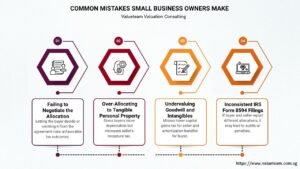
In another, the technology business was acquiring a smaller software business, but there was disagreement with its auditor regarding the discount rate applied to the smaller business’ technology asset as part of the chosen purchase price allocation method. The first rate was calculated using the company’s weighted average cost of capital and did not take into account the riskiness of the specific technology being valued. The team met with the independent valuation specialist again to revisit the assumption and determined that the technology had an increased fair value as a result and that the goodwill recognized was reduced because of the risk-adjusted rate used. In addition, the revised figure not only necessitated the updating of the deferred tax account for the intangible asset but also an indirect effect, which was not foreseen in the original workplan. This case highlights one of the most common technical mistakes made by less experienced purchase price allocation teams: applying the same discount rate to all assets instead of using the rate that is most appropriate to each asset’s risk profile.
Benefits and Challenges of a Well-Run Purchase Price Allocation Process
The benefits of a well-done purchase price allocation process are not limited to meeting accounting criteria. It provides the acquirer with a much better understanding of what value it has acquired, to assist with post-merger integration planning, and to help inform post-acquisition investment decisions in the acquired capabilities. Being able to do well in this domain is a great asset for professionals who want to gain credibility across the valuation, audit, and corporate development aspects of the job, and it shows a high level of technical rigor that many employers are seeking when recruiting for deal-facing roles. A clear allocation also tends to make it easier to defend the allocation methods used in the purchase prices to auditors and regulators because there is clear documentation of the assumptions behind each allocation method used.
The problems are just as substantial! The data quality of the target company is often less complete and reliable, especially for target companies that are privately owned with less formal reporting structures, and valuation specialists frequently find it necessary to generate data as opposed to relying on clean, audit-ready data sets. There may also be tight timelines to adhere to, as the majority of the accounting standards mandate that the allocation be finalised within a measurement period of up to twelve months from the acquisition date, which means that a complex valuation exercise may be required to be completed quickly. Experienced in the practice of M&A purchase price allocation, professionals are often surprised by the amount of cross-functional coordination that is required, as the allocation relies on the same assumptions across the members of the deal team, operational leadership, tax advisors and external valuers. Rework often occurs when there are some gaps in understanding among these teams, such as when financial reporting and tax teams use different taxable or nontaxable lives for an asset. Experienced practitioners know how to avoid this rework by maintaining regular alignment discussions.
Conclusion: Actionable Insights
Ultimately, the PPA steps in to confirm consideration, identify all of the assets and liabilities acquired, implement a defensible PPA method for each asset category, and determine and record goodwill. The practical next steps for those who are beginning to develop a career in this area are relatively easy to follow: familiarise yourself with the fundamental valuation principles applicable to different asset categories; practise some of the competencies of identifying intangible assets that may not be listed in a target’s current balance sheet; and learn the importance of documenting the reasoning and principles behind the valuations as seriously as the numbers – a supported rationale will survive audit scrutiny. As well, if possible, watch a live M&A purchase price allocation discussion of a contested assumption, as this will provide a learning opportunity regarding judgement that is no different from watching a real thing. Knowing how to do purchase price allocation calculations is one of the most useful and widely applicable skills among those employed in or associated with M&A.